Money
The Jewish Wealth Rule: Why 90% of Christian Families Lose Their Wealth (The 33-33-33 Rule)
Have you ever wondered why some families manage to preserve their wealth for centuries, while others watch it vanish in just a few generations?
Statistics show a devastating trend: traditional families often lose 70% of their wealth by the second generation, and a massive 90% by the third. Most people assume the difference comes down to luck, timing, or raw intelligence. But history proves otherwise. The real secret isn’t a complex stock market strategy—it is a simple, 3,000-year-old financial code: 33, 33, 33.
While modern financial advisors constantly tell you to “diversify” by spreading your money across various stocks, bonds, and mutual funds, ancient wisdom reveals a dangerous flaw in this plan. In reality, most people have 90% of their hard-earned money sitting in a single, vulnerable bucket.
In this article, we are going to break down the ancient “Rule of Thirds”—a biblical allocation system that has survived every major economic collapse in history. You’ll discover the exact three buckets you need to build, why the ratio must never change, and a step-by-step 5-year plan to rebalance your net worth safely.
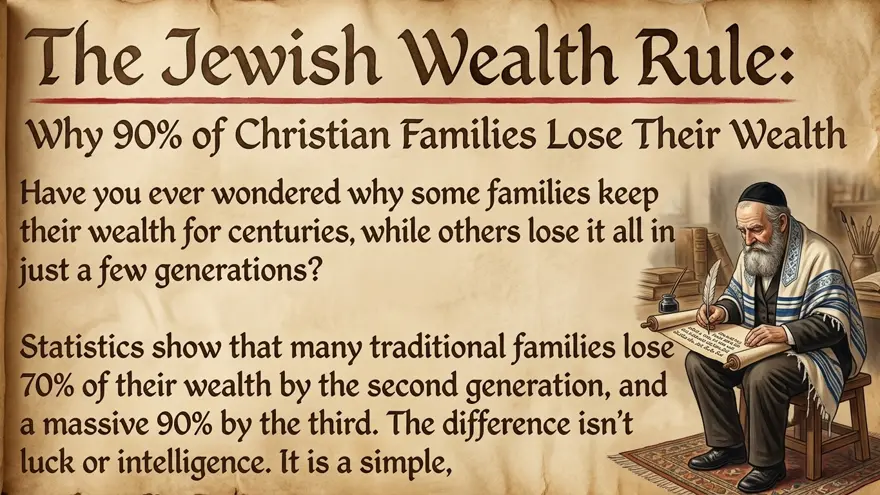
The 3,000-Year Secret to Generational Wealth: The Power of 33-33-33
Chapter 1: The Hidden Code of the Century
For generations, a striking financial divide has persisted. Statistics show that while many Jewish families successfully preserve their wealth for over a hundred years, nearly 70% of Christian families lose their fortune by the second generation, and a staggering 90% lose it by the third.
The underlying reason for this difference is not luck, nor is it superior intelligence. It is a precise, three-number code: 33-33-33.
King Solomon encoded this secret in the biblical book of Ecclesiastes, and Jewish law later codified it in the Talmud. It is a wealth allocation system that has survived every major economic collapse for the past 3,000 years.
Most modern financial advisors offer standard advice: “Diversify your wealth. Spread your money across various stocks and bonds.” Millions follow this guidance, believing they are safe. However, ancient wisdom suggests otherwise. Under traditional Jewish legal analysis, stocks, bonds, and savings accounts all fall into the exact same category. This means many people unwittingly keep up to 90% of their wealth in a single financial bucket, leaving them highly vulnerable to a major market crash.
The ancient Hebrews divided their wealth into three distinct, equal buckets:
- Land
- Business
- Liquid Assets
The allocation must be precise: exactly 1/3 of total wealth in each category. This is not modern portfolio theory; it is a time-tested asset allocation rule. It protected families through ancient exiles, the fall of empires, the Great Depression, the 2008 financial crisis, and modern economic disruptions.
Chapter 2: The Myth of Modern Diversification
When modern financial advisors tell you to diversify, the specific percentages they recommend often remain vague or fluid. Some suggest a 60/40 split between stocks and bonds, while others say 70/30, shifting the numbers based on your age or risk tolerance. This creates a system of guessing rather than a systematic framework.
Consequently, many individuals hold 85% to 95% of their net worth inside a single electronic portfolio—401ks, IRAs, brokerage accounts, and emergency funds. While these portfolios hold a mix of mutual funds and bonds, they remain highly correlated. When major economic shocks occur, these portfolios can easily lose 30% to 60% of their value in a matter of weeks.
The problem is not a lack of effort; it is that modern finance often relies on vague instructions. In contrast, ancient biblical law provides exact numbers: three buckets, with 33% in each.
The ancient Hebrews called this the Rule of Thirds. Why exactly three buckets?
- Two buckets create instability; if one crashes, half of your entire wealth vanishes instantly.
- Four or five buckets dilute your focus, making the assets difficult to manage effectively.
- Three buckets represent completeness, perfectly balancing risk, growth, and accessibility.
When King Solomon built his historically wealthy kingdom, he utilized this exact breakdown:
- Land: He held extensive vineyards, olive groves, and fields throughout Israel.
- Business: He managed international trade routes, merchant fleets sailing to Tarshish, and copper mining operations.
- Liquid Assets: As recorded in historical texts, he accumulated vast reserves of gold in his treasury to deploy at a moment’s notice.
Chapter 3: Bucket 1 – The Permanence of Land
Leviticus 25:23: “The land must not be sold permanently, because the land is mine.”
The land bucket includes anything fixed directly to the earth that you own: real estate, farmland, timberland, and mineral rights. Land cannot be printed by a government, and it cannot be inflated away.
When a government prints excess currency, cash loses its purchasing power and stock markets can become highly volatile. However, physical earth remains unchanged. A piece of land that could support a family or grow a crop centuries ago retains that same intrinsic value today.
Consider historical hyperinflation, such as in 1920s Germany. Those who held paper currency, traditional bonds, and standard corporate shares saw their life savings wiped out as a loaf of bread came to cost billions of marks. Meanwhile, those who owned physical land and buildings survived because the real asset retained its core value.
Modern Implementation
In a modern context, your land bucket includes:
- Residential real estate and rental properties.
- Farmland and commercial property.
- Real Estate Investment Trusts (REITs) — though these must be counted carefully since they trade publicly like stocks.
A common mistake is counting your primary home as total diversification when it actually makes up 60% or more of your net worth. That is concentration, not balance. The goal is to keep this bucket at exactly 33%. If you exceed that number, you become vulnerable to real estate crashes. If you drop below it, you lose your core protection against inflation.
Chapter 4: Bucket 2 – The Engine of Business
While land preserves purchasing power, it does not naturally generate aggressive operational income. That is the job of the second bucket: Business.
The business bucket consists of direct equity ownership in operating companies that produce tangible goods or services. This does not mean buying a few shares of a public tech stock on an app; it means holding a true stake in businesses that generate active cash flow.
Businesses are naturally adaptive. When inflation rises, a good business raises its prices. When technology changes, the business pivots. When consumer demand shifts, it creates new products. While land sits static and liquid assets wait passively, business actively produces wealth.
King Solomon did not merely passively invest; he operated businesses. He built fleets of merchant ships at Ezion-geber to trade across the seas, bringing back substantial annual revenues to his treasury.
During the Great Depression, the public stock market crashed by nearly 89%, and many traditional bonds defaulted. Yet local grocery stores, repair shops, and basic utility providers continued to operate. Their revenues fell, but they did not drop to zero. The families who owned actual operating businesses maintained a lifeline of income, while those who held nothing but paper stock certificates were devastated.
Modern Implementation
Today, your business bucket can be built through:
- Ownership in your own company if you are an entrepreneur.
- Serving as a silent partner in local businesses (e.g., medical practices, restaurants, or service companies).
- Private equity or curated small-business crowdfunding platforms.
- Owning revenue-generating intellectual property or royalty streams.
Publicly traded stocks do not belong here. When you buy a share of a massive public corporation, you hold a highly liquid financial claim that you can sell in two clicks. That belongs in your liquid bucket, not your business bucket.
Chapter 5: Bucket 3 – The Strategy of Liquidity
The third bucket is Liquidity. This includes any asset that can be seamlessly converted into cash within 30 days: physical cash, standard savings accounts, money market funds, short-term treasury bills, and publicly traded stocks or bonds.
Many people view liquidity purely as a safety net for emergencies. However, in this system, liquidity is used for offense.
When economic crises hit—such as the Great Depression or the 2008 collapse—asset prices plunge. Land and businesses suddenly sell for a fraction of their actual value. Those who keep 33% of their wealth entirely liquid are positioned to step in and buy high-quality assets from desperate sellers at deep discounts. A few years later, when the market recovers, those assets often multiply in value.
                  ┌──────────────────────────────┐
                  │      THE 33-33-33 SYSTEM     │
                  └──────────────┬───────────────┘
                                 │
         ┌───────────────────────┼───────────────────────┐
         ▼                       ▼                       ▼
┌─────────────────┐     ┌─────────────────┐     ┌─────────────────┐
│     LAND        │     │    BUSINESS     │     │    LIQUID       │
│  (Preserves)    │     │   (Generates)   │     │    (Offense)    │
├─────────────────┤     ├─────────────────┤     ├─────────────────┤
│ • Real Estate   │     │ • Own Company   │     │ • Cash/Savings  │
│ • Farmland      │     │ • Partnerships  │     │ • Public Stocks │
│ • Timberland    │     │ • Private Equity│     │ • Short-Bonds   │
└─────────────────┘     └─────────────────┘     └─────────────────┘
Warren Buffett’s investment strategy mirrors this concept. His holding company historically maintains tens of billions of dollars in cash reserves, intentionally earning low yields for years, simply waiting for a market correction to buy valuable businesses at a discount.
The typical mistake is keeping too much wealth in this bucket. Most people hold 90% or more of their net worth in liquid accounts (like 401ks, IRAs, and savings). They believe this is safe because the numbers are visible on a screen.
But when a severe market downturn occurs, they have no real estate generating rent and no independent business producing cash flow. To pay daily expenses, they are forced to sell their liquid stocks at the absolute bottom of the market. This is exactly how generational wealth is destroyed.
Chapter 6: Decoding Ecclesiastes 11
To understand where this formula originates, we look directly at the text of Ecclesiastes:
Ecclesiastes 11:2: “Invest in seven ventures, yes, in eight, for you do not know what disaster may come upon the land.”
Historically, many people read this verse as simple poetic advice about charity or general faith. However, ancient legal tradition interprets it as a practical mathematical framework for asset allocation:
- “Ship your grain across the sea” refers to active business, trade, and commerce.
- “After many days you may receive a return” defines a long-term, generational investment horizon rather than short-term trading.
- “For you do not know what disaster may come upon the land” acknowledges systemic risk. When an unexpected crisis hits one specific sector, the other two independent buckets shield the family from total ruin.
The instruction to invest in seven or eight ventures means diversifying within each bucket, rather than scattering money randomly.
For example, you should not put your entire 33% land allocation into a single rental property; instead, split it among two or three distinct properties. Do not place your entire 33% business allocation into one venture; divide it among a few different operations. In total, your wealth should be spread across seven to eight distinct positions across the three primary buckets.
                       TOTAL PORTFOLIO (100%)
                                 │
        ┌────────────────────────┼────────────────────────┐
        ▼                        ▼                        ▼
   LAND (33.3%)          BUSINESS (33.3%)          LIQUID (33.3%)
        │                        │                        │
  ┌─────┴─────┐            ┌─────┴─────┐            ┌─────┴─────┐
  ▼           ▼            ▼           ▼            ▼           ▼
Asset A     Asset B      Asset C     Asset D      Asset E     Asset F
The Talmud explicitly formalized this framework 1,500 years ago, stating that an individual should always divide their money into three parts: a third in land, a third in merchandise (business), and a third readily at hand (liquid).
Chapter 7: A Tale of Two Families
To see how this works in practice, let us examine the historical tracking of two families during the Great Depression of 1929. Both families lived in the same neighborhood, maintained the exact same social standing, and possessed a net worth of $100,000—a massive fortune at the time.
Family A: The Cohen Family (Following the Rule of Thirds)
The Cohens structured their $100,000 using the 33-33-33 allocation:
- Land (33%): $33,000 across three small rental properties in Brooklyn, generating stable monthly rent.
- Business (33%): $33,000 as a silent partner in a local commercial grocery business, generating steady cash distributions.
- Liquid (34%): $34,000 held in cash reserves and blue-chip treasury notes.
Family B: The Smith Family (Following Modern Conventional Advice)
The Smiths followed the standard financial advice of the roaring twenties, placing 100% of their wealth into highly rated liquid stocks like U.S. Steel, General Electric, and RCA.
The Crash of 1929 and Its Aftermath
When the market collapsed, the stock market shed roughly 89% of its total value by 1932.
| Financial Metric (1932) | The Cohen Family (33-33-33 System) | The Smith Family (100% Liquid Stocks) |
| Liquid Bucket Value | Dropped from $34,000 to $3,700 (89% drop) | Dropped from $100,000 to $11,000 (89% drop) |
| Land Bucket Value | Market value fell 50% to $16,500, but tenants still paid regular, slightly adjusted rent. | $0 (No land assets owned) |
| Business Bucket Value | Grocery sales slowed, but people still needed food. Equity remained intact, yielding steady cash. | $0 (No direct business equity) |
| Total Net Worth | $54,000 (A manageable 46% total loss) | $11,000 (A devastating 89% total loss) |
| Ongoing Cash Flow | Maintained. Rental income and business distributions covered all living expenses. | Zero. Forced to liquidate remaining stocks at the absolute bottom to survive. |
The Generational Outcome
Because the Cohens had ongoing cash flow, they never had to touch their damaged liquid bucket. Instead, they used their remaining $3,700 in liquid cash to buy additional real estate from distressed sellers for pennies on the dollar. By the time the economy recovered in the 1940s, the Cohen estate had multiplied significantly. The wealth passed safely to their children and grandchildren.
Conversely, the Smith family had to liquidate their remaining stock shares at historic lows just to pay for food and housing. They were wiped out within 36 months. The estate vanished, and no wealth remained for future generations.
Chapter 8: The 5-Year Rebalancing Protocol
Transitioning an imbalanced modern portfolio to this ancient model requires a careful, methodical approach. Do not liquidate your entire retirement portfolio tomorrow; that would trigger immediate, massive tax penalties. Instead, utilize a structured 5-Year Rebalancing Plan.
Step 1: Calculate Your True Baseline
Add up every single asset you own to find your absolute net worth. Categorize them honestly:
- Liquid: 401ks, IRAs, stocks, mutual funds, bonds, CDs, checking and savings accounts.
- Land: Total equity in your primary residence, rental properties, or raw land.
- Business: True equity value in private businesses or direct partnerships (excluding public stocks).
Divide each category by your total net worth to find your current percentages. Most people discover their allocation looks like this: 90% Liquid / 10% Land / 0% Business.
Step 2: Redirect Your New Capital (Year 1)
Stop automatically pouring 100% of your excess monthly income or corporate bonuses into your liquid accounts. Instead, direct all new savings toward your deficient buckets. If you save $20,000 this year, allocate $10,000 toward building a real estate down payment (Land) and $10,000 toward private business equity or crowdfunding opportunities (Business).
Step 3: Gradual Portfolio Realignment (Years 2–5)
Over the next four years, slowly and methodically systematically move capital out of your over-concentrated liquid bucket. Work within tax-advantaged strategies, utilizing small annual distributions, Roth conversions, or tax-loss harvesting to gradually fund your land and business allocations. Aim to move the needle closer to the 33% target each year to minimize tax exposure.
Step 4: Overcoming Capital Shortfalls
If you lack the capital to buy large pieces of real estate or acquire whole companies outright, use collaborative methods:
- For Land: Look into real estate hacking (such as buying a duplex and renting out one side), participating in high-quality agricultural/farmland fractional platforms, or partnering with trusted family members to pool down payments.
- For Business: Explore structured equity crowdfunding platforms that let you buy stakes in private operating businesses with low minimums, or look into acquiring small, existing cash-flowing operations using seller financing.
Chapter 9: The Legacy of Stewardship
Proverbs 13:22: “A good person leaves an inheritance for their children’s children.”
Notice the exact timeline specified by ancient text: it does not say your children, it says your children’s children—your grandchildren.
True financial stewardship requires looking past your own retirement horizon. If you choose to maintain an allocation that is 90% liquid, you remain exposed to systemic market corrections. Under that exposure, future generations often inherit a diminished portfolio, compounding the risk until the family wealth disappears entirely.
The 33-33-33 allocation is designed to build a self-sustaining financial engine. When you balance your resources evenly across Land, Business, and Liquid assets, you create a robust structure. One hundred years from now, your descendants can inherit an estate featuring land that has appreciated over time, private business operations that deliver consistent cash flow, and accessible liquid reserves ready to capitalize on market opportunities.
A Prayer for Generational Wisdom
For those who wish to align their financial stewardship with these foundational principles, consider this reflection:
“Father, we recognize that we are temporary stewards of the wealth and resources entrusted to us. We acknowledge that conventional financial models often encourage concentration in paper assets, mistaking market access for true safety.
Grant us the clarity to evaluate our holdings honestly and the discipline to implement structure where there is imbalance. Give us the patience to rebalance our assets methodically, protecting our household from inflation through land, sustaining our work through active business, and maintaining liquid reserves to act wisely in times of economic correction.
May the decisions we make today establish a stable foundation, allowing us to leave a lasting, honorable inheritance for generations to come. Amen.”
Frequently Asked Questions (FAQ)
1. Does my primary residence count toward my 33% Land bucket?
Yes, but only up to a point. Your home equity (the market value minus your remaining mortgage) counts toward the Land bucket. However, the most common pitfall is overconcentration. If your home equity makes up 70% of your total net worth, you are technically over-allocated in land and vulnerable to real estate downturns. In that scenario, you should stop adding money to real estate and focus entirely on building your liquid and business buckets until the ratio balances out.
2. Why don’t publicly traded stocks count as the “Business” bucket?
While buying a share of a public company technically gives you a fractional slice of ownership, the function of that asset is purely liquid. You can sell public stocks in two clicks on your smartphone and convert them to cash in seconds. Furthermore, public stocks are highly correlated with the broader liquid markets—when a panic hits Wall Street, your stock portfolio crashes regardless of how well the underlying business is performing. The Business bucket requires direct, private equity ownership where your returns are driven by actual operational cash flow, not public market sentiment.
3. How can I safely invest in “Business” if I have zero entrepreneurial experience?
You do not need to run a company to own business equity. There are three primary ways to build this bucket passively:
- Silent Partnerships: Provide capital to a trusted friend, family member, or local entrepreneur who has the expertise but needs funding to scale. You receive a structured share of the monthly or quarterly profits while they handle operations.
- Equity Crowdfunding: Modern regulatory frameworks allow everyday investors to buy small equity stakes in private startups or established local businesses via vetted online platforms, often for low minimum amounts.
- Royalty Streams: Investing in intellectual property, such as music catalogs, software licensing, or patented products, allows you to collect ongoing operational income without managing a physical business.
4. Won’t selling my 401k or IRA to rebalance trigger massive tax penalties?
It can if you do it recklessly, which is why the system mandates a gradual, 5-year transition. Moving 90% liquidity into equal thirds overnight is a recipe for a massive tax bill. Instead, apply a slow rebalancing protocol:
- Direct 100% of all new savings and excess income into your deficient land and business buckets first.
- Utilize strategic, smaller annual withdrawals or Roth conversions over half a decade to spread out the tax burden.
- Consult with a specialized tax professional to utilize tools like tax-loss harvesting or self-directed IRAs (which allow you to hold real estate and private business equity directly inside a tax-sheltered account).
5. What happens if one bucket grows much faster than the others?
The system requires an annual rebalancing check (historically done at the turn of the year). Because markets move, your allocation will naturally fluctuate. The operational rule is to allow a plus or minus 3% tolerance. If your business bucket booms and suddenly accounts for 38% of your net worth, you harvest a portion of those business profits and deliberately redistribute them into your underallocated land or liquid buckets to bring the system back to a strict 33-33-33 split.
Conclusion
The Choice Is Yours: A Broken Portfolio or a 100-Year Legacy?
At the end of the day, building generational wealth isn’t just about accumulating numbers on a screen; it’s about responsibility. As the ancient proverb goes, a good person leaves an inheritance that reaches all the way to their children’s children.
If you keep 90% of your net worth tied up in highly liquid, volatile paper assets, the next major market crash won’t just hurt your retirement—it could completely wipe out the legacy your grandchildren were meant to inherit.
By shifting your mindset from modern guessing to the time-tested 33-33-33 allocation, you balance your financial ecosystem perfectly:
- Land to preserve your purchasing power against inflation.
- Business to generate active, adaptable cash flow.
- Liquid assets to play offense and seize life-changing opportunities during economic downturns.
Rebalancing your wealth doesn’t happen overnight, but the choices you make today will echo for the next 100 years. Take a hard look at your numbers this week, identify your empty buckets, and start building a foundation that no market crash can tear down.
What do you think? Which of the three buckets do you need to work on the most? Drop a comment below and let’s discuss! Don’t forget to subscribe to our newsletter for more deep dives into timeless wealth wisdom.


 Relationships Quotes3 years ago
337+ Relationship Quotes And Sayings
- Good Morning Quotes1 year ago
100+ Good Morning Quotes to Brighten Your Day: Inspirational, Romantic & Funny Messages with Images
- Quotes1 year ago
300 Winnie The Pooh Quotes To Fill Your Heart With Joy
- Quotes3 years ago
35 Deep Heart Touching One Sided Love Quotes for Her
- Good Morning Quotes3 years ago
57 of the Good Morning Quotes And Images Positive Energy for Good Morning
- Good Morning Quotes3 years ago
35 of the Good Morning Quotes And Images Positive Energy for Good Morning
- Life Quotes3 years ago
284 Broken Heart Quotes About Breakup And Heartbroken Sayings
- Motivational Quotes3 years ago
265 Motivational & Inspirational Quotes About Life to Succeed


