Stoicism
Marcus Aurelius – How To Build Self-Discipline (Stoicism)
Have you ever looked at the sheer mountain of goals you want to achieve, only to watch your motivation vanish the moment you feel tired, stressed, or slightly uncomfortable? How To Build Self-Discipline?
You are not alone. In a modern world saturated with cheap distractions, instant gratification, and constant notifications, building real, lasting self-discipline feels harder than ever. We try productivity hacks, download focus apps, and wait for that elusive spark of inspiration—yet we still find ourselves hitting the snooze button.
But what if the secret to unbreakable mental toughness wasn’t a modern hack at all? What if it was perfected nearly two thousand years ago by the most powerful man on the planet?
Enter Marcus Aurelius. As the Emperor of Rome from 161 to 180 A.D., he held absolute power over millions of lives and infinite wealth. He had every excuse to give in to luxury and laziness. Instead, while commanding armies on frozen, brutal battlefronts, he filled a private diary with raw, honest notes to himself on how to master his mind, conquer daily resistance, and build flawless character.
Today, that diary is known as Meditations—the ultimate handbook for Stoic discipline.
If you are ready to stop playing the victim, defeat procrastination, and build a mind that handles any hardship with calm confidence, you don’t need more advice. You need to follow the footprint of the Emperor. Let’s break down the ten timeless chapters of Marcus Aurelius’s blueprint for self-discipline.
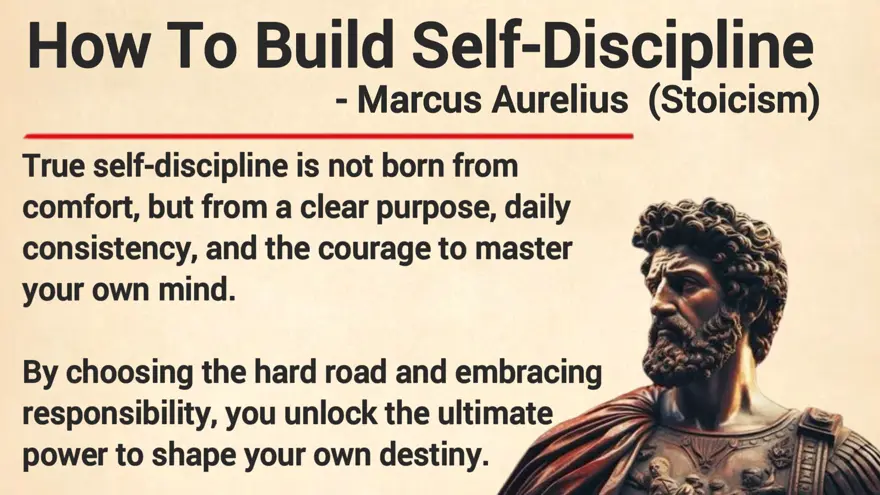
Introduction: The Emperor’s Secret
Imagine standing at the absolute peak of the world. You are the Emperor of Rome. Millions of people bow to your name. Untold wealth, absolute power, and every pleasure imaginable are yours for the taking. No one can tell you “no.”
Under such weight, most rulers break. They surrender to greed, laziness, and arrogance.
But one man did not. His name was Marcus Aurelius.
Ruling from 161 to 180 A.D., he was the last of the legendary “Five Good Emperors.” Yet, in the dead of night, huddled in military tents while fighting brutal wars on the frozen borders of the empire, Marcus did something remarkable. He did not write laws to praise himself. Instead, he wrote a private diary. He wrote to himself, for himself, to keep his mind strong.
Today, we call this book Meditations. It is one of the greatest guides to self-discipline ever written.
If you want to master your mind, conquer laziness, and build unbreakable discipline, you do not need modern hacks. You need the ancient wisdom of the Emperor. Here are his ten essential lessons, broken down step by step.
Chapter 1: Find Your True Purpose
“I have to go to work—as a human being. What do I have to complain of, if I’m going to do what I was born for? Or is this what I was created for? To huddle under the blankets and stay warm?”
Picture the scene: The morning sun is just starting to rise. It is freezing cold outside. Inside the imperial tent, Marcus Aurelius is warm beneath his heavy blankets. He is exhausted. He does not want to get up.
Does this sound familiar? We all face this exact battle with the snooze button.
But Marcus did not let himself slide into laziness. He reminded himself of a simple truth: Discipline starts with purpose.
Marcus believed that every creature on Earth has a job to do. The birds fly, the ants build, the spiders spin their webs. They all work to keep the world moving. So, why should a human being be any different? Were you born just to stay warm under a blanket?
When you have a deep, clear purpose, getting out of bed becomes easy. Think about a time you had a flat tire on your car. Your purpose was crystal clear: change the tire and get moving. You didn’t lie down and complain about being tired. You just did it because it had to be done.
The biggest secret to self-discipline is having a strong reason to act. If you don’t know what your purpose is yet, do not wait for inspiration to hit you. Just start doing. If you want to write, write every single day. If you want to paint, grab a brush and create. Do not waste time researching or waiting for the perfect moment. Dive into what interests you, and let that daily action build your inner drive. Purpose is the fuel that pushes you forward when everything else tells you to stop.
Chapter 2: Rely Only on Yourself
“Turn your desire to stone. Quench your appetites. Keep your mind centered on itself.”
Once you have found your purpose, you need a plan. But a plan is useless without full, unshakeable commitment. Marcus advises us to harden our minds against outside distractions and focus completely inward.
True self-discipline is the ability to take action no matter what. It does not care if you are tired, sad, angry, or bored. It means doing what needs to be done, whether you feel like it or not. Everything you want to achieve in this life depends entirely on this single ability.
How do you build this? You start by breaking big goals down into tiny, manageable pieces.
Do not just say, “I am going to write a book.” Instead, give yourself a firm deadline and create mini-milestones. Tell yourself, “I will write two pages every morning at 7:00 AM.”
When you break a giant goal into small chunks of time, you place yourself firmly in the driver’s seat. You take control. This prevents you from feeling overwhelmed. When you feel overwhelmed, procrastination creeps in. And when you procrastinate, your progress stops completely. Where things are standing still, discipline cannot live.
Chapter 3: Show Up Every Single Day
“You must build up your life action by action, and be content if each one achieves its goal as far as possible—and no one can keep you from this.”
Consider this shocking truth: even with a perfect purpose and a brilliant plan, 95% of people still fail.
Why? Because they do not show up consistently.
Great things are not built overnight. They are built brick by brick, day after day. The simple act of showing up—even when you are performing poorly—builds incredible mental strength. When you force yourself to sit at your desk or go to the gym day after day, you are training your mind to endure the long, boring, and difficult journey that success requires.
Self-discipline is just another word for the habit of consistency. You do the work over and over again until it becomes automatic, like breathing.
And if you slip up? If you miss a workout or eat a bad meal, do not panic. Missing one day does not ruin who you are. Your strength is measured by how quickly you get back on track. A bad day does not have to become a bad week. A bad week does not have to become a bad year. The moment your eyes open tomorrow morning, remember: it is a brand-new life. Focus entirely on the step right in front of you.
Chapter 4: Choose the Hard Road on Purpose
“We should discipline ourselves in small things, and from there progress to things of greater value. If you have a headache, practise not cursing… I’m not saying that you can’t complain, only don’t complain with your whole being.”
How do athletes prepare for a major race? They train under difficult conditions. They run uphill; they lift heavy weights. They make practice harder than the actual game.
The Stoics called this Voluntary Hardship.
If you want to build ironclad discipline, you must routinely make your life uncomfortable on purpose. By testing yourself in small ways during peaceful times, you prepare your mind for the heavy storms of life.
Voluntary hardship can be very simple:
- Skip a meal and tolerate being hungry for an evening.
- Take a freezing cold shower instead of a warm one.
- Leave your jacket at home on a chilly, rainy day.
- Put your smartphone in a drawer and lock it away for an entire weekend.
When you practice going without comforts, you realize something beautiful: you are much stronger than you think. You learn that you can survive discomfort, and the fear of hardship loses its power over you.
Chapter 5: Control What Is Inside You
“You have power over your mind – not outside events. Realize this, and you will find strength.”
Nothing destroys self-discipline faster than getting upset by things you cannot control. You sit down to work on your big project, but suddenly you get an annoying email, or the weather turns bad, or someone says something rude to you. Instantly, your focus vanishes, and your day is ruined.
Marcus Aurelius says this is a terrible way to live. He practiced what philosophers call the Dichotomy of Control.
Whenever you feel stressed, distracted, or angry, pause and ask yourself these simple questions:
Do you have a problem in your life?
  ├── No? ──> Then don't worry.
  └── Yes? ──> Can you do something about it?
            ├── Yes? ──> Then don't worry, take action.
            └── No? ──> Then don't worry, accept it.
If a situation is completely outside of your control, getting angry about it changes absolutely nothing. Accept it, let it go, and keep your focus on your own actions. That is where your true power lives.
Chapter 6: Never Play the Victim
“Do your job, without whining.”
Listen closely to the things people say when they fail.
- “I was just born this way.”
- “My parents raised me poorly.”
- “The system is rigged against me.”
- “Everyone else is doing it too.”
These are not reasons; they are excuses. They are words used to justify staying lazy instead of fighting to become better.
Marcus Aurelius tells us to banish the victim mentality completely. The moment you ask, “Why me?” you surrender your mental toughness. The situation might not be your fault, but taking charge of your life is entirely your responsibility.
It is incredibly easy to point fingers and blame others when things go wrong. It takes zero effort. But true leaders—those with real mental strength—step up and fix the problem, even if they didn’t cause it. When you act like a victim, you give away your power. Without a sense of personal ownership, you can never make meaningful progress.
Chapter 7: Wait for the Best Rewards
“So you were born to feel ‘nice’? Instead of doings things and experiencing them? Don’t you see the plants, the birds, the ants… going about their individual tasks? And you’re not willing to do your job as a human being?”
We live in a world designed for instant gratification. If we are hungry, we get fast food. If we are bored, we pull out our phones for a quick hit of social media. We are constantly searching for things that make us feel “nice” right now.
But Marcus asks a sharp question: Were you really born just to feel comfortable?
True discipline requires delayed gratification—the rare ability to wait for what you truly want.
Imagine walking into a party filled with delicious, sugary treats while you are trying to lose weight. If you give in and eat them, you enjoy a few minutes of pleasure. That is instant gratification. But if you choose the salad and carrot sticks instead, you unlock a much greater reward down the line: a healthier body, more energy, and the pride of fitting into your favorite clothes.
Discipline means trading minor comfort right now for major achievement later.
Chapter 8: Turn a Deaf Ear to the Doubters
“When another blames you or hates you… go to their souls, penetrate inside and see what sort of people they are. You will realize that there is no need to be racked with anxiety that they should hold any particular opinion about you.”
The moment you stand up and say, “I am going to change my life, build a business, or get in shape,” a strange thing happens. People will start trying to pull you down. These are the naysayers.
Sometimes, they are strangers. Other times, they are friends or family members who love you but are terrified of change.
Marcus Aurelius says that caring about the insults or opinions of critics is as foolish as getting angry at the weather. It is a complete waste of your mental energy. If you look closely at the souls of the people who criticize you, you will often find that they are deeply unhappy, insecure, or lazy themselves.
Never let an outsider disrupt your peace of mind. Seek honest feedback from people you deeply respect, but if someone is just shouting negativity from the sidelines, ignore them completely and keep moving forward.
Chapter 9: Walk with Giants
“It will even do to socialize with men of good character, in order to model your life on theirs, whether you choose someone living or someone from the past.”
You cannot build iron discipline entirely on your own. You need templates to follow. You need role models.
Look around you. Who do you know who is already living the way you want to live? Who has mastered the habits you are trying to build? It could be a friend, a coworker, a family member, or even a historical figure like Marcus Aurelius himself.
Once you find these people, study them. Ask them questions:
- How do you stay disciplined when you are exhausted?
- What routines do you follow every single day?
- How do you bounce back from failure?
Use their life maps to guide your own journey. By surrounding yourself with excellent people—either in real life or through the books you read—you naturally raise your own standards.
Chapter 10: Review Your Day with Brutal Honesty
“These are the characteristics of the rational soul: self-awareness, self-examination, and self-determination. It reaps its own harvest… It succeeds in its own purpose.”
At the end of every single day, the Roman Emperor sat down alone with his thoughts. He reviewed his actions with absolute, radical honesty.
If you want to grow, you must look into the mirror every night and ask yourself three critical questions:
- What did I do well today? Where did I show self-control and strength?
- Where did I falter? Where did my discipline break, and why did it happen?
- How can I do better tomorrow? What concrete step can I take to improve?
This evening review connects you directly with your mind. It keeps you sharp. But remember: do not use this time to beat yourself up or fall into despair.
Be kind to yourself. Forgive your mistakes like a wise parent would. Studies show that forgiving yourself for your daily failures actually prevents you from procrastinating tomorrow. Celebrate your small wins, learn from your errors, express gratitude for the day, and close your eyes knowing you are ready to conquer tomorrow.
🙋♂️ Frequently Asked Questions (FAQ)
1. Who was Marcus Aurelius?
Marcus Aurelius was the Emperor of Rome from 161 to 180 A.D. and is remembered as the last of the “Five Good Emperors.” Despite holding absolute power over the western world, he is best known for his commitment to Stoic philosophy, justice, and intense personal discipline.
2. What is Meditations?
Meditations is not a book Marcus Aurelius wrote for the public. It is a collection of his private journals and sticky-note-like reminders to himself. He wrote them while on military campaigns to stay grounded, calm, and disciplined amidst the stress of ruling an empire.
3. What is the “Dichotomy of Control” in Stoicism?
Coined by the Stoic philosopher Epictetus (whom Marcus deeply admired), the Dichotomy of Control is the practice of splitting life into two categories: things you can control (your thoughts, actions, and reactions) and things you cannot control (the weather, other people, and external outcomes). Stoic discipline relies on focusing 100% of your energy only on what you can control.
4. What is “Voluntary Hardship” and why should I do it?
Voluntary hardship means introducing small, intentional discomforts into your daily life—like taking a cold shower, fasting for a meal, or skipping social media. By practicing scarcity when times are good, you toughen your mind so that you are never paralyzed when real, unexpected hardships hit you.
5. How can I practice Stoic discipline if I lack motivation?
Stoics do not rely on motivation because motivation is an emotion that comes and goes. Instead, they rely on purpose and habits. Marcus Aurelius argued that when you know your purpose (your duty as a human being), you show up and do the work action-by-action, regardless of whether you “feel” like it or not.
6. Is Stoicism about erasing all human emotions?
No. This is a common misconception. Stoicism is not about becoming a cold, unfeeling robot. It is about reducing destructive emotions—like rage, anxiety, and deep grief—so that you can think clearly, act justly, and maintain absolute control over your own choices.
Conclusion
At its core, Stoic self-discipline is not about punishing yourself or living a cold, joyless life. It is about reclaiming your freedom. When you let your mood, your laziness, or outside events dictate what you do, you are not free—you are a slave to your impulses.
Marcus Aurelius didn’t conquer his mind because it was easy. He did it because he knew that a life without purpose and consistency is a life wasted. By waking up with intent, choosing the hard road on purpose, relying entirely on your own actions, and reviewing your progress with radical honesty, you build an internal fortress that no outside storm can destroy.
The blankets are warm, and the bed is comfortable. But you weren’t created just to stay warm. You were born to do the work of a human being.
Tomorrow morning, when your alarm sounds and the temptation to slide back into comfort creeps in, remember the Emperor’s secret: Open your eyes, focus on the single step right in front of you, and build your destiny—action by action.
💬 What part of your life needs the “Emperor’s discipline” the most right now? Are you going to practice voluntary hardship or focus on finding your true purpose? Let’s discuss in the comments below!


 Relationships Quotes3 years ago
337+ Relationship Quotes And Sayings
- Good Morning Quotes1 year ago
100+ Good Morning Quotes to Brighten Your Day: Inspirational, Romantic & Funny Messages with Images
- Quotes1 year ago
300 Winnie The Pooh Quotes To Fill Your Heart With Joy
- Quotes3 years ago
35 Deep Heart Touching One Sided Love Quotes for Her
- Good Morning Quotes3 years ago
57 of the Good Morning Quotes And Images Positive Energy for Good Morning
- Good Morning Quotes3 years ago
35 of the Good Morning Quotes And Images Positive Energy for Good Morning
- Life Quotes3 years ago
284 Broken Heart Quotes About Breakup And Heartbroken Sayings
- Motivational Quotes3 years ago
265 Motivational & Inspirational Quotes About Life to Succeed


