Life
Psychology Of People Who Forget Names Instantly
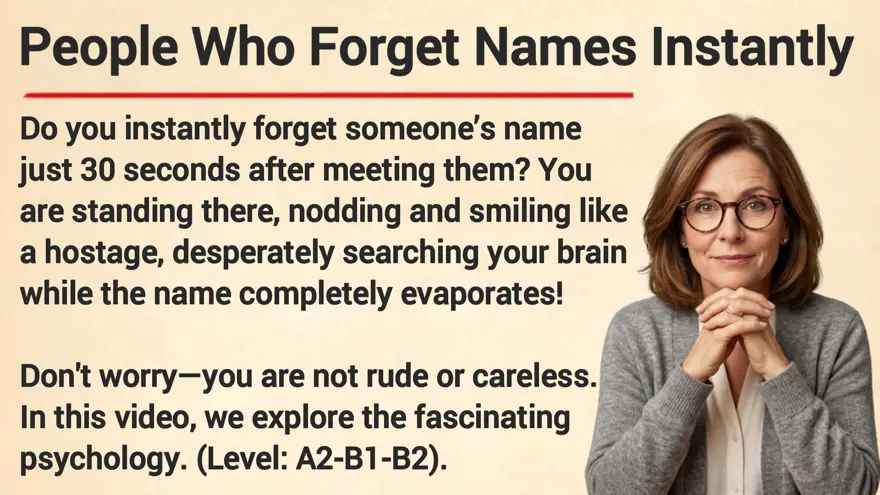
You just got introduced to someone 30 seconds ago, and you already have absolutely no idea what their name is. It is completely gone. Now, you are standing there, nodding and smiling like a hostage while desperately searching your brain for a label that simply vanished. here, Psychology Of People Who Forget Names Instantly.
Does this sound familiar? Don’t worry—you are not rude, and you are definitely not careless.
In this article, we are diving deep into the fascinating neuroscience and psychology behind why our minds ruthlessly delete names while remembering faces, clothes, and stories perfectly. As a language learner or deep thinker, understanding how your memory files information will completely change how you view your brain. Let’s look at what is actually happening beneath the surface.
The Island in Your Brain: Why Names Evaporate
Chapter 1: The Smiling Hostage
It happens in a flash.
You meet someone new. You shake hands. You smile. Thirty seconds pass, and suddenly, a wave of cold panic hits you. Their name is completely gone. It has been utterly erased from your mind.
Now, you are standing there, nodding and smiling like a hostage. Your eyes are wide, and your brain is frantically searching through dark corners for a word that simply does not exist anymore.
You are not a rude person. You are not careless. But something truly fascinating is happening inside your head right now—something most people never get explained to them.
Why do names disappear so fast, while almost everything else stays? You can remember their face perfectly. You remember exactly what they were wearing. You might even remember the funny joke they told just a moment ago. But the name? It vanished into thin air, as if it never stood a chance.
Chapter 2: The Random Label
Neuroscientists have dug deep into this mystery, and what they found is brilliant. In the world of your brain, names are completely arbitrary. They are random.
Think about it this way: when you learn that a stove is hot, the word “hot” connects directly to a real human experience. It means heat, pain, and danger. Your brain instantly links that word to a physical feeling that keeps you alive.
But the name Michael tells your brain absolutely nothing useful about the person named Michael. It contains no emotion. It offers no survival value. It has no smell, no color, and no sound. It is just a random label floating out in the cold, completely isolated.
Your brain is a ruthlessly efficient machine. It loves to save energy, so it only stores information that connects to something else. Names connect to nothing. They are tiny, lonely islands in a massive ocean. Because there are no bridges leading to them, they easily slip through the cracks and sink.
Chapter 3: The Heavy Load
But the mystery goes deeper. When you meet someone new, your brain is not just listening; it is working overtime.
In a split second, you are reading their facial expressions. You are interpreting their body language. You are deciding, on a deep subconscious level, if this person is safe. At the same time, you are processing the loud environment around you and trying hard to manage your own social performance. You want to look polite, smart, and confident.
That is a massive amount of mental work.
Buried deep underneath all that heavy lifting is a single name, spoken only once, very quickly, with zero emotional weight. Your brain was simply too busy to open up a folder and file it properly. This is not forgetfulness. This is your brain prioritizing what matters most in the moment.
Chapter 4: The Next-in-Line Effect
Psychologists have a special term for part of this problem: The Next-in-Line Effect.
Imagine you are standing in a circle, and everyone is introducing themselves one by one. As the speaker before you is talking, your brain completely stops listening to them. Instead, it turns all its focus inward. You start practicing what you are about to say. You think about your own voice, your own name, and how you will sound.
Because your brain is focusing so intensely on your own upcoming performance, it barely registers the sound waves entering your ears. You physically heard the name, yes. But you were never actually listening.
Chapter 5: The Creative Mind
Here is a beautiful twist that might surprise you: people who forget names easily often have highly associative brains.
This means your memory works through deep connections and rich meanings, not isolated facts. You are likely exceptional at remembering stories, big concepts, deep emotions, and shared experiences. Why? Because those things naturally weave themselves into the grand web of your memory.
But names, as we know, are islands. They have no bridges. And a highly associative brain does not travel to lonely islands very well.
This is exactly why writers, artists, innovators, and deep thinkers are constantly forgetting names. Their minds are built for narrative, not nomenclature. They are built for stories, not labels. They will remember exactly how you made them feel. They will remember the unique sound of your laugh. They will remember the specific idea you shared that made them think differently.
But your name? Their brain filed it under “low priority” before you even finished saying the last syllable.
Chapter 6: The Thirty-Second Rule
We also have to look at the element of pure attention. In a busy social setting, we are rarely fully present. We are scanning the room, managing our inner anxiety, or wondering if we look okay. Only a tiny fraction of our attention catches the name, and then a distraction pulls us away before the magic can happen.
Science shows us that for new information to stick, it needs about 30 seconds of focused, unbroken attention. That is how long it takes to move something from your temporary working memory into your brain’s long-term storage unit.
Thirty seconds. That is all it takes.
But in a normal social introduction, how much time do you actually get? Maybe three seconds. The name arrives like a drop of water on a hot pan—and it evaporates before your brain can do anything useful with it.
Chapter 7: The Anxious Cousin
Then comes the quiet shame, which makes everything worse.
The exact moment you realize you have forgotten the name, a small wave of panic activates. Now, your mental energy is split in half. You are trying to stay present in the conversation, but inside, you are frantically screaming and digging for a name you never stored in the first place.
The harder you reach for it, the further it runs away. This is the anxious cousin of the tip-of-the-tongue phenomenon. The name isn’t completely gone, but it is blocked. Your own stress response is now standing like a wall between you and the word you need.
Chapter 8: The Power of the Bridge
There is a fascinating biological side to this, too. Research shows that a chemical called dopamine plays a massive role in how we save memories. When something exciting or important happens, dopamine spikes. It acts like a bright neon sign in your brain that flashes: “This matters! Save this right now!”
A regular name in a brief meeting almost never triggers dopamine. There is no surprise, no reward, and no emotional spark in those few syllables.
But what if you attach that name to a vivid story? Suddenly, dopamine fires. What if you learn that a person’s name has a powerful history, or you connect it to a wild, colorful visual image in your mind? Suddenly, the name sticks.
The brain itself didn’t change. The input did.
This is the exact secret of world-class memory champions. They can memorize hundreds of random names in a few minutes. They are not born with superhuman brains. Instead, they have learned how to instantly convert dry, boring labels into vibrant, emotional, visual stories. They build the bridge the brain needs to cross the water.
Chapter 9: The Quiet Truth
So, what does all of this mean for you?
If you are someone who constantly forgets names, take a deep breath. You are not absent-minded. You are not selfish or self-absorbed. Your brain is working exactly the way it was designed to work. It is filtering out the noise, saving energy, and prioritizing deep meaning over random data. The name simply didn’t make the cut.
The fix is not to struggle or force yourself to try harder in the moment. The fix is to give your brain a physical anchor.
- Repeat the name out loud immediately after you hear it.
- Look at their face and connect their name to a striking visual image.
- Create a tiny, five-second story in your head.
Give the lonely island a bridge.
And if you find yourself in the middle of a chat and the name has already evaporated into the mist? Just ask. Do it directly, and do it warmly. Say, “I am so sorry, my brain just dropped your name. Could you tell me one more time?”
Almost no one gets offended by this. Why? Because every single person in that room has been exactly where you are standing. They have all smiled that frozen, hostage smile, hoping desperately that nobody would notice they were drawing a complete blank.
Because here is the beautiful, quiet truth underneath it all: forgetting someone’s name does not mean you didn’t care about them. It usually means your brain was far too busy experiencing them to care about the label.
And honestly, that is not the worst thing in the world.
Conclusion
Giving Your Brain a Bridge
At the end of the day, forgetting someone’s name instantly doesn’t mean you don’t care about them. It simply means your associative brain was far too busy experiencing their unique personality, body language, and energy to properly file a random text label.
Your brain is working exactly as it was designed to—prioritizing deep human meaning over isolated words.
The next time you find yourself drawing a blank mid-conversation, don’t panic. Take a breath, smile warmly, and ask them directly. You will find that most people are incredibly happy to repeat it, simply because they have been in your exact shoes before.
What about you? Do you struggle to remember names, or do you have a secret trick that helps you link faces to labels instantly? Drop your thoughts in the comments section below—I read and reply to every single one!


 Relationships Quotes3 years ago
337+ Relationship Quotes And Sayings
- Good Morning Quotes1 year ago
100+ Good Morning Quotes to Brighten Your Day: Inspirational, Romantic & Funny Messages with Images
- Quotes1 year ago
300 Winnie The Pooh Quotes To Fill Your Heart With Joy
- Quotes3 years ago
35 Deep Heart Touching One Sided Love Quotes for Her
- Good Morning Quotes3 years ago
57 of the Good Morning Quotes And Images Positive Energy for Good Morning
- Good Morning Quotes3 years ago
35 of the Good Morning Quotes And Images Positive Energy for Good Morning
- Life Quotes3 years ago
284 Broken Heart Quotes About Breakup And Heartbroken Sayings
- Motivational Quotes3 years ago
265 Motivational & Inspirational Quotes About Life to Succeed


