Money
Why Saying “NO” to a Promotion Made Him Richer (And Saved His Career)
At forty-seven years old, Mark sat in a small, windowless HR conference room. The air was cool, the fluorescent lights hummed a clinical buzz, and on the floor sat an empty cardboard box. In his lap was a severance packet with his name spelled wrong on the label.
Only five years earlier, this same office was full of cake and congratulations. Mark had accepted a promotion to Operations Manager, stepping up to a shiny new $145,000 salary. Everyone told him the exact same thing: “You earned this.”
But two floors up, a man named Evan was still working. He was the exact same age, at the exact same company, yet he was earning more money, enjoying more freedom, and was harder to replace than ever before.
Here is the twist that should change how you view your entire career: Five years ago, Evan was offered the exact same promotion that Mark accepted. Evan said no.
How does the man who rejects a major raise end up wealthier and more secure than the man who climbed the ladder?
This isn’t a post about why ambition is bad, or why promotions are always a trap. It is a story about a very specific kind of corporate trap—the kind that quietly trades your freedom for a title. If you are currently working hard in your 30s or 40s, the decisions you make today will dictate where you sit five years from now.
Let’s look at the five hidden traps inside almost every promotion, and the exact strategy one man used to choose freedom over a badge.
The Bitter Cost of a Fancy Title
A story of two men, one choice, and the quiet trap of “moving up.”
Prologue: The Cold Fluorescent Light
At forty-seven years old, Mark sat in a small, windowless Human Resources conference room. The air was cool, smelling faintly of carpet cleaner and cheap paper. Overhead, the fluorescent lights hummed a low, clinical buzz.
In his lap, he held a plastic-coated folder. On the floor by his left shoe sat a single, empty cardboard box. Tucked inside the folder was a severance packet, the label hastily printed. They had spelled his name wrong. Marc.
Five years ago, this same office had smelled like vanilla icing and cheap champagne. Five years ago, people were crowding around his desk, enthusiastically shaking his hand. A bright blue banner hung from the ceiling tiles: CONGRATULATIONS, MARK!
He had just accepted a promotion to Operations Manager, stepping up to a $145,000 salary. He remembered the warm rush of pride. His colleagues had patted his back, offering the same reassuring phrase: “You earned this, man. You really did.”
Two floors up, in a quiet office bathed in natural light, another man was still working. He was the exact same age. He worked for the exact same company. Yet, he was earning more than he had five years ago, his schedule was entirely his own, and he was harder to replace than he had ever been.
His name was Evan.
And here is the part of the story that should make you pause: Five years ago, Evan had been offered the exact same promotion that Mark accepted.
Evan had looked at the offer, looked at his life, and said no.
How does the man who rejects the raise end up with more money, more security, and more peace of mind?
This isn’t a story about why ambition is bad, or why you should never climb the ladder. Some promotions are wonderful. Some people are natural-born leaders, and some raises genuinely buy you freedom.
Instead, this is a story about a specific kind of promotion—the kind that quietly trades your freedom for a title. It is about the five warning signs that were hiding in plain sight, if only someone had known where to look.
This story didn’t begin in the HR room with a cardboard box. It began five years earlier, when both men were forty-two, balancing mortgages, soccer practices, and a golden opportunity.
Chapter 1: The Fork in the Road
At forty-two, Mark and Evan were professional twins. They worked in the same department as Senior Operations Specialists. They were the “engine room” of the company—the guys who actually understood how the systems worked, the ones who kept the wheels spinning.
- Their Age: 42
- Their Salary: $120,000
- Their Lives: Both had mortgages, busy kids, and a 401(k) they promised themselves they would contribute more to “next year.”
- Their Inner Lives: Both felt that quiet, persistent mid-life anxiety—the feeling that they should be further ahead by now.
Then, the department head resigned. A management position opened up.
[Senior Specialist] $120,000 ───► Both Men at Age 42
                                     │
                      ┌──────────────┴──────────────┐
                      ▼                             ▼
               [Mark Accepts]                 [Evan Declines]
             Management Role                Senior Specialist
               $145,000                       $120,000
To Mark, the choice was obvious. It was a $25,000 jump. He saw the shiny new number and pictured his exact same job, just with a loftier title stapled to the top of his email signature.
But Evan did something different. Before he gave his answer, he sat down with the hiring director and asked one simple, practical question:
“Walk me through a typical week for this role. What does the calendar actually look like?”
The answer told Evan everything he needed to know. The title was a step up, but the daily work was an entirely different language. Evan politely declined. Mark signed the paperwork.
Chapter 2: Trap #1 — Changing the Work, Not Just the Title
Within three months, Mark realized he hadn’t received a raise; he had exchanged his calendar for a leash.
As a specialist, Mark’s day was about solving concrete problems. He was great at it. He would log on, fix the issue, and feel a sense of completion.
Now, his days were an endless, interlocking chain of back-to-back meetings. He was writing performance reviews, defending budgets to executives who didn’t understand the tech, and dealing with interpersonal drama. The problems of thirty different people were now dropped directly onto his desk.
One rainy Tuesday afternoon, Mark found himself sitting through a grueling, two-hour meeting about a third-party vendor contract. He barely understood the legal jargon, and he realized with a sinking heart: I don’t actually do the work I love anymore. My job is just explaining to other people why the work isn’t done yet.
Evan, meanwhile, kept his head down. Because he had said no, his calendar remained clean. He spent his days doing the deep, focused work he was brilliant at. He went home at 5:00 PM with a clear mind.
Chapter 3: Trap #2 — The Illusion of the Big Raise
On paper, $25,000 is a massive win. But Mark quickly met the cold reality of tax brackets.
After federal, state, and local taxes, that $25,000 raise shrank to about $17,000 of actual take-home pay. That breaks down to roughly $1,400 a month.
But where did that money go?
- The Commute & Convenience: Because Mark was working late, he and his wife started ordering takeout three or four nights a week. They were simply too exhausted to cook.
- The “Manager” Image: Mark felt he needed to look the part. He leased a slightly nicer, mid-sized luxury SUV. “A manager should drive a manager’s car,” he justified to himself.
- The Stress Relief: Weekend trips and expensive dinners became “rewards” for surviving another brutal week.
That $1,400 monthly bump was entirely swallowed up before a single dollar could touch his savings.
Evan’s paycheck grew more slowly, but it was “clean” money. He had no extra stress, which meant no “stress-spending.” He kept his reliable old sedan, cooked his meals at home, and quietly adjusted his automatic 401(k) contribution up by 2%. A few months later, he pushed it up another 2%. He set up a Roth IRA to fund itself on autopilot.
One night, after missing his son’s baseball game because a budget meeting ran until 7:30 PM, Mark opened his banking app in his driveway. He stared at the screen, hoping the balance would somehow make him feel better.
It didn’t. The numbers were flat, but his time was gone.
Chapter 4: Trap #3 — The Peter Principle in Real Time
There is a famous concept in business called The Peter Principle:
In a hierarchy, every employee tends to rise to their level of incompetence.
In simple terms, people who are excellent at their jobs get promoted until they are placed in a job they are bad at, where they remain.
Researchers have observed this clearly in sales departments. The absolute best, most charismatic sales reps get promoted to Sales Manager. But the instincts required to sell are completely opposite to the patience and coaching required to manage. The result? The company loses its best salesperson and gains a mediocre manager.
This was Mark’s tragedy. He was an elite problem solver, but he was a thoroughly average manager. He wasn’t lazy; he was simply using the wrong toolset.
Evan stayed exactly where his skill line was highest. By refusing management, he spent five years becoming the absolute master of the company’s core systems. He became the irreplaceable specialist.
Chapter 5: Trap #4 — The Target on Your Back
By year three, Mark had the mahogany desk. He had the “Director of Operations” badge. He had the glowing LinkedIn update that gathered hundreds of thumbs-up emojis from strangers.
He also had a massive, invisible target on his back.
In corporate economics, workers generally fall into two categories:
| Group | Corporate View | Security Level |
| Individual Contributors (Evan) | Revenue generators & system keepers. The people who do the work that keeps the lights on. | High (Hard to replace without operations grinding to a halt) |
| Middle Management (Mark) | Overhead cost. They coordinate work but do not directly produce the product. | Low (First to be circled in red during a budget cut) |
When a company experiences a bad quarter, executives look at the payroll spreadsheet. A specialist earning $120,000 who keeps the servers running is dangerous to fire. But a middle manager earning $145,000 who sits in meetings? That looks like an easy way to save six figures in a single afternoon.
Chapter 6: Trap #5 — The Strategic “No”
When Evan declined the promotion years ago, he didn’t just say, “No thanks, I’m good.” He treated it as a negotiation.
He sat down with his VP and framed his value clearly:
“I know where I build the most value for this company, and it is in the technical architecture, not in managing people’s schedules. Let me stay here. Let me take on our hardest operational bottlenecks, mentor the incoming junior staff, and let’s structure my compensation around my technical expertise.”
It felt slightly awkward for a week or two. A few coworkers whispered that Evan had “lost his drive.” One even asked him at the coffee machine if he was “scared of the responsibility.”
But Evan wasn’t scared. He had simply stopped confusing a fancy title with real leverage.
He kept his evenings. He kept his skills incredibly sharp. He let his emergency fund grow to a comfortable six months of living expenses, while Mark’s savings remained chronically thin.
Epilogue: The Day the Music Stopped
In the fifth year, the restructuring memo was sent out.
Mark had assumed his title was armor. It wasn’t. When the executives sat down with the organizational chart, they didn’t look at his late nights or his loyalty. They looked at cost centers.
Mark’s name was added to a spreadsheet weeks before he ever suspected a thing.
Which brings us back to that quiet HR conference room. Mark, holding his misspelled severance packet, realizing the ladder he had climbed so desperately was leaning against the wrong wall.
Two floors up, Evan sat at his desk. He had just come out of a meeting with his director. There was no severance packet. Instead, they had offered him a specialist retention bonus and a salary adjustment to keep him from leaving for a competitor.
The vast difference in their lives didn’t come down to luck, talent, or who worked harder. It came down to recognizing the five quiet traps of the corporate ladder.
                  RESTRUCTURE EVENT
                          │
         ┌────────────────┴────────────────┐
         ▼                                 ▼
   [Mark: Manager]                 [Evan: Specialist]
   • High overhead cost            • Indispensable skill set
   • Easily automated/merged       • Directly keeps system alive
         │                                 │
         ▼                                 ▼
   Layoff List                     Retention Bonus & Raise
Before you say “yes” to your next promotion, close your eyes and look past the salary number. Ask yourself:
- What will my daily calendar actually look like?
- What will this do to my energy, my family, and my boundaries?
- Am I accepting a job I will love, or am I just buying a title?
Because the wrong promotion doesn’t lift you up. It just gives you a higher place to fall from.
🙋♂️ Frequently Asked Questions (FAQ)
Q1: Is climbing the corporate ladder always a bad idea?
No, absolutely not. Some people are genuinely built for leadership and thrive on organizing teams, steering strategy, and solving high-level business problems.
The story is a warning against blindly accepting a promotion just for the money or the title without understanding how it will change your daily life. If you love execution and “doing the work,” shifting into management might trade your happiness for a modest raise.
Q2: What exactly is the “Peter Principle”?
The Peter Principle is an economic concept stating that employees tend to be promoted up to their level of incompetence.
This happens because companies promote people based on their performance in their current role, rather than their suitability for the new role. For example, an elite programmer gets promoted to manager, only to find they are bad at managing people—so they remain stuck in a job they struggle with.
Q3: How can I grow my salary if I refuse to become a manager?
You don’t need to manage people to make more money. You can follow the Individual Contributor (IC) track.
Many modern companies offer parallel career paths. As shown below, you can climb the ladder as an expert specialist without taking on management responsibilities:
- Go deeper, not wider: Become the go-to expert in a critical, complex system that the company cannot run without.
- Negotiate value over hours: Ask for raises based on the specific revenue you generate or costs you cut, not just your tenure.
- Consulting / Freelancing: Leverage your deep specialist skills to work with external clients on your own terms.
Q4: How do I say “No” to a promotion without looking lazy or ruining my career?
It is all about framing. Never say, “No thanks, that sounds like too much work.” Instead, frame your refusal as a strategic decision that benefits the company.
Use this script:
“I appreciate this offer immensely. However, I’ve looked closely at where I drive the absolute most value for this team, and it’s on the execution side. If I move into management, the company loses my primary technical skills. I’d love to discuss how I can expand my impact as a Senior Specialist instead.”
Q5: Why is middle management usually the first to get laid off?
Middle management is often viewed as “overhead.” They act as coordinators and buffers between the executives and the executors.
When a company needs to cut costs quickly, they look for roles that do not directly build the product, write the code, or close the sales. Because individual contributors (like Evan) keep the core machinery running, they are much harder and more dangerous to lay off than a manager who coordinates meetings.
Conclusion
By the time the corporate restructuring hit in year five, Mark’s title—which he thought was armor—proved to be nothing more than a target. In corporate economics, middle management is viewed as a costly overhead expense. The individual contributors doing the deep, technical work are the ones who are impossible to route around.
The vast difference between Mark’s folding chair and Evan’s retention bonus didn’t come down to luck, talent, or who worked harder. It came down to recognizing the heavy price tag attached to the wrong career move.
Evan’s wealth grew because he kept his lifestyle steady, protected his health, and let his investments compound undisturbed. He never had to raid his savings to cover the emotional and physical cost of a job that was quietly draining him.
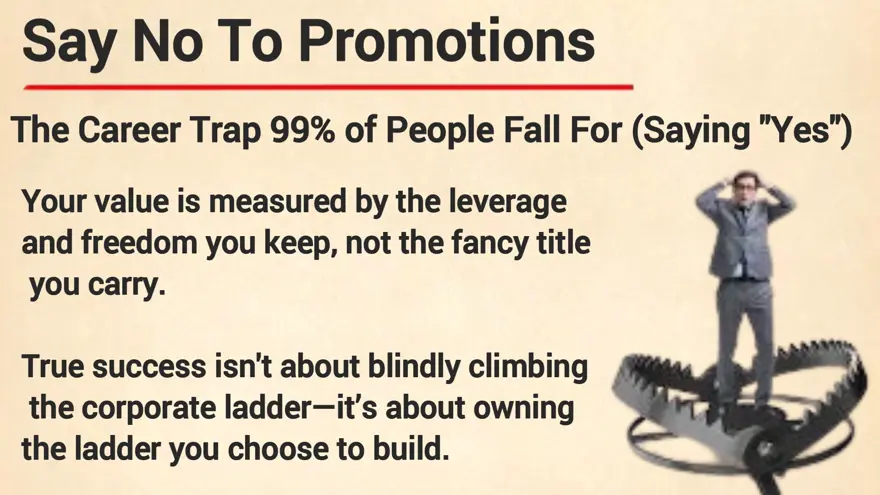
The ultimate lesson is simple: A promotion is only progress if it buys you more freedom. If it sells your freedom back to your employer, it isn’t a raise—it’s a trap.
Before you accept the next title handed to you, look past the salary number. Look at your calendar, look at your energy, and remember that sometimes, the most profitable word you can say for your career is a strategic “No.”


 Relationships Quotes3 years ago
337+ Relationship Quotes And Sayings
- Good Morning Quotes1 year ago
100+ Good Morning Quotes to Brighten Your Day: Inspirational, Romantic & Funny Messages with Images
- Quotes1 year ago
300 Winnie The Pooh Quotes To Fill Your Heart With Joy
- Quotes3 years ago
35 Deep Heart Touching One Sided Love Quotes for Her
- Good Morning Quotes3 years ago
57 of the Good Morning Quotes And Images Positive Energy for Good Morning
- Good Morning Quotes3 years ago
35 of the Good Morning Quotes And Images Positive Energy for Good Morning
- Life Quotes3 years ago
284 Broken Heart Quotes About Breakup And Heartbroken Sayings
- Motivational Quotes3 years ago
265 Motivational & Inspirational Quotes About Life to Succeed


