Money
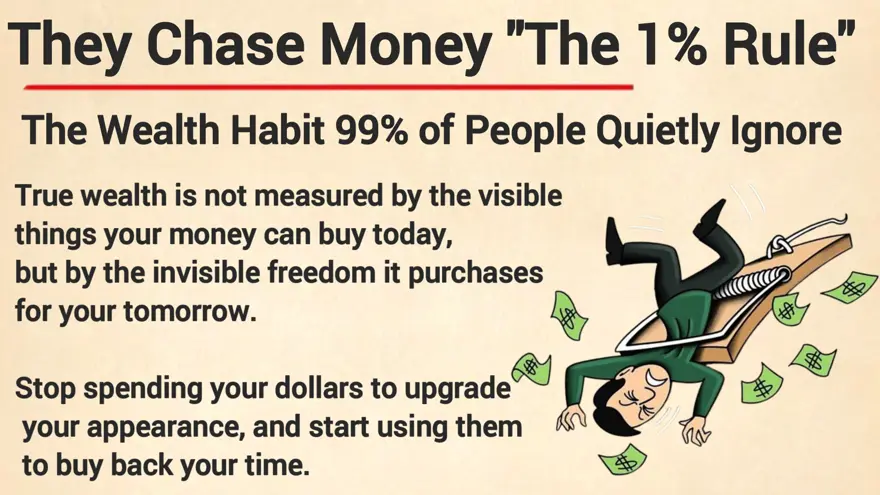
They Chase Money: The Wealth Habit 99% of People Quietly Ignore
What if the biggest reason you are still chasing financial freedom (They Chase Money) has absolutely nothing to do with how much money you bring home?
It is a paradox we see every day. Two people can receive the exact same paycheck, live in the same neighborhood, shop at the same stores, and eventually retire into completely different worlds. One finishes life with deep financial peace and ultimate flexibility, while the other remains trapped on the endless corporate treadmill, stressed and burned out.
The difference isn’t that one worked harder. It isn’t that one mastered the stock market or found a lucky crypto coin.
Instead, it comes down to a psychological skill so ordinary that almost nobody talks about it. It is an invisible habit hiding inside every promotion you celebrate, every purchase you justify, and every dollar you quietly let pass through your fingers. The unsettling truth is this: once you see it, you cannot unsee it. Your car, your phone, and even your morning coffee will never look the same again.
In this post, we are breaking down the quiet, chapter-by-chapter shift that separates those who spend their lives working for money from those who force their money to work for them. Here is the wealth habit that 99% of people quietly ignore.
Chapter 1: The Invisible Divide
What if the biggest reason you are still chasing financial freedom has nothing to do with how much money you bring home?
Imagine two people. They receive the exact same paycheck. They live in the same bustling city, walk the same streets, and shop at the exact same stores. Yet, decades later, they retire into completely different worlds. One lives a life of deep peace and complete freedom. The other is still trapped on the endless treadmill of work, stressed and tired.
Why does this happen? It is not because one worked harder. It is not because one was smarter. It is because one quietly noticed something the other never did.
Most people think the secret is investing. They think it is strict budgeting, or finding the next hot stock before anyone else. But it isn’t. The real secret is a skill so ordinary, so quiet, that almost nobody talks about it. It is a hidden skill that sits inside every financial decision you make. It is there when you celebrate a promotion, when you justify a new purchase, and when you quietly let an opportunity pass by without ever realizing what it was actually worth.
The unsettling part is this: once you see it, you cannot unsee it.
Suddenly, the expensive luxury car in your neighbor’s driveway starts looking different. The latest smartphone doesn’t look like just a phone anymore. Even your morning cup of coffee begins to ask you a question it has never asked before.
The wealthiest people do not just look at the world differently. They are seeing an entirely different world.
Chapter 2: The Two Shoppers
There is a grocery store a few miles from your house. You have probably been there dozens of times. You walk through the automatic sliding doors, grab a shopping cart that insists on pulling slightly to the left, and walk down the aisles. You pick up milk, eggs, bread, and maybe a few extra items you didn’t plan to buy. Finally, you stand in the checkout line, scrolling through your phone while waiting to pay. It feels like one of the most ordinary, boring places in your week.
Now, imagine two people walking into that exact same store.
- The first person sees prices. They notice that the box of cereal has become more expensive. They think about the cost of today’s dinner.
- The second person sees ownership. They look at the same box of cereal and quietly wonder: Who manufactures this? Who owns the trucks that delivered it? Who owns the land beneath this very building? Who collects the rent from this grocery chain every month? Which company processes every credit card payment happening inside this store right now?
They both leave the store with the exact same groceries. But only one leaves with an idea.
To most, that difference seems tiny and insignificant. But it is everything. Fortunes are rarely built during grand, extraordinary moments. They are built through thousands of completely ordinary moments that everyone else ignores.
Most people believe wealthy individuals think about money all the time. They don’t. They simply think about it differently. They have trained their minds to ask questions that almost never occur to the average person—questions that do not offer instant gratification, questions that take years before they produce any visible reward. And that is exactly why almost nobody asks them.
Our brains are remarkably good at solving immediate problems. We ask: How do I make more money this year? How do I afford a bigger house? How do I upgrade my lifestyle now that I got a raise?
But the questions that quietly create true wealth are much less exciting. They are slower, more patient, and almost boring. Yet, hidden inside those boring questions is the pattern that separates people who spend decades working for money from the people whose money eventually begins working for them.
Chapter 3: The Tale of Two Paths
This pattern does not reveal itself overnight. It hides inside decisions so small they hardly feel like decisions at all. A purchase here, a promotion there, a weekend impulse, a conversation you almost forget happened. Individually, these moments look meaningless. Together, they build two entirely different lives.
Consider two co-workers who start the exact same job on the exact same Monday morning. They have the same office, the same salary, and the same benefits. They even park on the same level of the parking garage.
Five years later, from the outside, one looks like a massive success. The other looks totally ordinary.
The first co-worker gets a big promotion. To celebrate, he leases a luxury SUV. He moves into a beautiful high-rise apartment with floor-to-ceiling windows because, after all, he has worked hard and earned it. His wardrobe becomes expensive. His vacations become grand. His social media profile slowly turns into a beautiful travel brochure, filled with rooftop dinners, airport lounges, and weekends permanently bathed in golden sunlight.
People notice. His friends assume he is doing incredibly well. His family points to him as the one who finally “made it.”
The second co-worker gets the exact same promotion, with the exact same raise. But he still drives his old car. He stays in the same modest neighborhood. His phone is four years old. His watch tells the time and nothing else. When people ask if he is finally going to upgrade his house, he just shrugs and says, “Maybe someday.”
Nobody notices him. If anything, some people quietly assume he lacks ambition or drive.
But something unusual is happening beneath the surface of both lives. One is using every single raise to upgrade his appearance. The other is using every single raise to upgrade his future.
Neither decision feels dramatic in the moment. And that is how the story always begins. Not with one giant mistake, and not with one brilliant investment. Just thousands of ordinary decisions pointing in completely different directions.
Chapter 4: The Price of the Future
Here is where most people get confused: they think wealth is built by earning more money. It isn’t.
If income alone created wealth, every professional athlete would retire rich, every lottery winner would stay wealthy, and every high-paid surgeon would be financially free. But we already know that is not how the story ends. Earning money and keeping money require two completely different ways of thinking. Earning rewards speed; keeping rewards patience.
One asks: “What can I afford today?” The other asks a question that almost sounds unfair: “What am I giving up tomorrow?”
Most people never ask that second question. It is not because they aren’t smart. It is because our entire culture trains us not to ask it. Every advertisement, every luxury commercial, and every social media influencer showing off a new purchase is quietly teaching the same lesson: If your life looks successful, it must be successful.
That is a remarkably expensive misunderstanding.
The average person learns to measure financial success by visible upgrades—a bigger house, a newer car, designer labels, business-class flights. The problem is not that these things are bad. The problem is what they silently replace. Every visible upgrade usually comes at the cost of an invisible one.
It replaces the upgraded investment account nobody sees. It replaces the retirement contribution nobody applauds. It replaces the emergency fund that never gets posted online. It replaces the ownership stake that quietly grows while everyone else is busy comparing lifestyles.
The strange thing about invisible wealth is that it almost always loses the popularity contest… until the day it finally wins the math.
And when that day comes, everyone else thinks luck was involved. They see someone becoming financially free in their fifties or sixties and assume they discovered a secret stock, a hidden opportunity, or perfect timing. They never look backward far enough to notice what was actually happening twenty years earlier.
The real story began with a habit so ordinary that most people dismissed it as boring. And ironically, boring is exactly what made it so powerful.
Chapter 5: What Can This Become?
Think back to the last time you received unexpected money. Maybe it was a tax refund, a year-end bonus, a commission check, or simply a month where your expenses were lower than usual. For the first time in a while, there was money left over.
What was the very first question that entered your mind? Not the answer—the question. Because that is where everything quietly begins.
For most people, the mind immediately starts searching for upgrades: a better vacation, a newer phone, the kitchen renovation they’ve wanted for years, or the watch they have looked at a dozen times. None of these thoughts are bad or crazy. They are completely human.
But there is another type of person who receives the exact same amount of money and experiences something entirely different. Their first thought is not, “What can this buy?” Their first thought is, “What can this become?”
That sounds like a small difference, but it is a massive canyon. It is the difference between seeing money as an ending, and seeing money as the beginning of something new.
Children naturally think only in the present. If you hand a ten-year-old one hundred dollars, they immediately imagine the toys they can get right now. Adults are not much different. The only difference is that our toys become more expensive. The toy car becomes a luxury SUV. The bicycle becomes a vacation home. The candy becomes a designer handbag. The brain never stopped asking the same childhood question; it just raised the price tag.
The people who build extraordinary wealth train themselves to interrupt that automatic question. They don’t just fight it—they interrupt it. They realize that every single dollar arrives carrying two different futures:
- The first future disappears the moment the dollar is spent.
- The second future continues to grow and compound long after you have forgotten where the dollar even came from.
Most people only ever see the first future. The wealthy learn to see both.
Chapter 6: The Secret in Plain Sight
This is why wealthy people often appear strangely unemotional around money. They are not immune to wanting beautiful things. They simply see something standing right behind those things.
Imagine walking into a car dealership and finding the exact vehicle you have always wanted. The leather smells brand new. The paint reflects the afternoon sun like polished glass. The salesperson smiles and tells you the monthly payment fits perfectly within your current budget. For a moment, buying it feels like the obvious choice.
Then, another voice quietly enters the conversation. It doesn’t ask, “Can I afford this?” That is an easy question. The harder question it asks is, “What does this monthly payment replace?”
Suddenly, that monthly payment is not just a car payment anymore. It is years of future investment returns. It is your safety net during the next recession. It is the freedom to leave a stressful job you no longer enjoy. It is another year your retirement arrives sooner instead of later.
The car hasn’t changed, but the way you see it has completely shifted.
This is how two people can stand in front of the exact same item and make completely different decisions, without either one feeling like they are making a painful sacrifice. One sees consumption; the other sees ownership. One sees today’s comfort; the other sees tomorrow’s freedom.
Repeated hundreds of times over twenty or thirty years, those tiny differences stop looking like simple choices. They start looking like destiny.
This way of thinking does not make life feel restrictive or cheap. It actually makes life feel much calmer. Every financial decision stops being a painful test of willpower. It simply becomes a comparison between two futures: one that feels good today, and one that quietly gives you options for decades to come.
If you have ever met someone who seems completely unbothered by keeping up with the trends, someone who does not rush to upgrade their life after every raise, someone who is strangely patient while everyone else is sprinting—you are not looking at someone with superpower discipline. You are looking at someone who learned to see what most people miss.
The greatest financial advantage is not having more dollars. It is learning to see the years of freedom hidden inside every single one of them.
Chapter 7: The True Cost of Trading
Economists use a phrase that sounds almost too simple to matter: Opportunity Cost. Most people hear those words once in a school classroom, answer a few exam questions, and never think about them again. The quietly wealthy build their entire lives around them.
They realize that every financial decision has two prices: the price you pay today, and the price you don’t notice until years later.
Imagine it is a Friday afternoon. You just received a $15,000 bonus. Your mind is suddenly filled with exciting possibilities: the luxury watch, the kitchen remodel, or the dream vacation you promised yourself after working so hard.
There is nothing wrong with wanting these things. The mistake is believing the price tag tells the whole story.
The watch does not actually cost $15,000. It costs whatever that $15,000 would have quietly become if you had left it alone to grow. The vacation does not end when the plane lands; its financial story keeps unfolding long after the photos disappear from your phone feed. The remodeled kitchen is not just cabinets and countertops; it is every future opportunity that money can no longer create because it was asked to solve today’s desire instead of building tomorrow’s freedom.
That is the part almost nobody sees. The future is invisible; the present is right in front of us. And human beings are always drawn toward what they can see.
That is why saving money feels so unnatural. People call it discipline, but discipline suggests you are constantly fighting yourself. The people who quietly become wealthy are not fighting every purchase. They have just changed the conversation entirely.
Where everyone else sees spending, they see trading. They ask themselves if they want to trade tomorrow’s freedom for today’s temporary excitement. Sometimes that trade is worth making. Many times, it isn’t.
Once your mind starts recognizing those trades, something amazing happens. The excitement of buying starts lasting a little less, and the excitement of owning your future starts lasting much, much longer.
Chapter 8: The Scorecard of Freedom
There is a retired engineer living in a quiet neighborhood outside Minneapolis. If you drove past his house, nothing would make you slow down. His driveway holds a twelve-year-old pickup truck. His lawn isn’t perfect. His mailbox leans slightly to the side from a winter storm that happened three years ago.
But inside his investment account sits more money than most people in his town will earn in their entire working lives.
People assume he just isn’t interested in nice things. They are only half right. He loves beautiful cars. He enjoys luxury hotels. He appreciates fine restaurants. But he discovered something decades ago that most people never fully understand: Every purchase asks a question. Would you rather own this object, or the freedom it could have built?
Sometimes the vacation is worth every dollar. Sometimes the family memory is the greatest investment you will ever make. The quietly wealthy understand this. This is not about refusing to enjoy life. It is about refusing to spend money without understanding what you are giving away.
Over thirty years, that mindset changes everything. Wealth is built through completely ordinary Tuesdays.
- The Tuesday you decided not to upgrade the car.
- The Tuesday you increased your savings contribution instead.
- The Tuesday you walked out of a store thinking you missed out, only to realize years later that you had actually purchased something much larger.
You didn’t just buy another asset or investment. You purchased time. You purchased options. You purchased freedom. You bought a future version of yourself who wakes up one morning and realizes that work has become a choice instead of a survival necessity.
Chapter 9: The Destiny We Choose
The investment portfolio, the successful business, the financial freedom—none of those things were the true beginning. They were just the final results.
The real work happened years earlier, in hundreds of ordinary moments that nobody celebrated. It happened while standing inside a dealership, scrolling through homes online, receiving a bonus, or looking at a paycheck. It came down to looking at something you wanted and asking the quiet question: “What am I giving up if I choose this today?”
That is the real skill. Investing is simply the tool, but this mindset is the driver.
It is the skill of thinking in decades while everyone else is thinking in weekends. It is the skill of seeing opportunity where everyone else only sees a price tag.
Once you develop this way of thinking, envy disappears. A brand-new luxury SUV driving past you doesn’t create jealousy anymore; it creates curiosity. You wonder what that money replaced. Did it replace an investment account? A paid-off house? The freedom to retire five years early? Maybe nothing, maybe everything. You simply don’t know.
And that is exactly why you stop keeping score using someone else’s life. You have quietly adopted a different scoreboard—one that almost nobody else can see.
Delayed gratification is not a life of sad sacrifice. It is a life filled with incredible choices:
- The choice to work because you enjoy it, not because you have to.
- The choice to help your children without hurting your own retirement.
- The choice to walk away from a toxic job without wondering how you will pay next month’s bills.
- The choice to sleep peacefully during a recession because your foundation was built years before the storm arrived.
Those choices do not suddenly appear out of nowhere. They are purchased one patient decision at a time, one ordinary Tuesday at a time.
Years from now, you will forget most of the things you almost bought. You will forget the phone that became outdated, the car that got old, and the items that lost their shine. But you will never regret owning your time. You will never regret buying yourself peace of mind. You will never regret building a future where money stops controlling your life.
In the end, the wealthy didn’t just master investing before everyone else. They mastered themselves. They understood that every single dollar is more than just money. It is time. It is freedom. It is a vote for the person you are becoming.
Every single day, you are casting that vote. When your future and your present want the exact same dollar… which one wins?
🙋♂️ Frequently Asked Questions
1. What is the “Invisible Skill” that creates true wealth?
The invisible skill is the ability to see opportunity cost instead of just a price tag. While most people look at a dollar and ask, “What can this buy me today?” wealthy individuals look at that same dollar and ask, “What can this become for me tomorrow?” It is the habit of treating money as a tool for future ownership rather than temporary consumption.
2. Why doesn’t a high income automatically lead to financial freedom?
Earning money and keeping money require completely different mindsets. A high income rewards speed, talent, or hard work, but keeping money requires patience and self-discipline. Without the wealth habit of delaying gratification, earning more money simply leads to lifestyle inflation—where your expenses rise just as fast as your income.
3. Does building wealth mean I have to sacrifice enjoying my life today?
Not at all. The goal isn’t to live a life of strict deprivation. It is about making intentional trades. The quietly wealthy still enjoy nice vacations, dinners, and cars; they simply refuse to spend money on things that don’t add real value to their lives. They value the security of owning their time more than the temporary rush of a visible status symbol.
4. What is the difference between a visible upgrade and an invisible upgrade?
- A visible upgrade is something the world can see and applaud—a brand-new luxury SUV, designer clothing, or a massive house.
- An invisible upgrade is something nobody sees but you—a growing investment account, a maxed-out retirement fund, or a 6-month emergency cash buffer. Visible wealth wins the popularity contest today, but invisible wealth wins the math tomorrow.
5. How can I start practicing this wealth habit right now?
Start by interrupting your automatic spending impulses. The next time you get a raise, a bonus, or cash left over at the end of the month, pause before spending it. Don’t ask yourself if you can afford the monthly payment. Ask yourself: “What am I giving up tomorrow if I buy this today?” Use that extra money to buy assets (stocks, real estate, savings) that buy back your future time.
Conclusion
At its core, true financial freedom was never about beating the market; it was about mastering yourself. The quietly wealthy understand a truth that our hyper-consumer culture spends billions of dollars trying to make you forget: a dollar is not just a unit of currency to be traded for temporary comfort. It is a unit of time. It is a piece of freedom. It is a literal vote for the future version of yourself.
Delayed gratification is not a life sentence of miserable sacrifice. It is a passport to a life filled with options—the option to walk away from a toxic job, to sleep peacefully through a recession, and to work because you want to, not because you have to.
Every single day, you are casting a vote for your destiny. So, the next time your present impulses and your future freedom fight over the exact same dollar, ask yourself the only question that truly matters: Which one deserves to win?
💬 Now, it’s your turn: What is one visible lifestyle upgrade you are choosing to skip this month so you can buy back your future time? Let’s talk about it in the comments below!


 Relationships Quotes3 years ago
337+ Relationship Quotes And Sayings
- Good Morning Quotes1 year ago
100+ Good Morning Quotes to Brighten Your Day: Inspirational, Romantic & Funny Messages with Images
- Quotes1 year ago
300 Winnie The Pooh Quotes To Fill Your Heart With Joy
- Quotes3 years ago
35 Deep Heart Touching One Sided Love Quotes for Her
- Good Morning Quotes3 years ago
57 of the Good Morning Quotes And Images Positive Energy for Good Morning
- Good Morning Quotes3 years ago
35 of the Good Morning Quotes And Images Positive Energy for Good Morning
- Life Quotes3 years ago
284 Broken Heart Quotes About Breakup And Heartbroken Sayings
- Motivational Quotes3 years ago
265 Motivational & Inspirational Quotes About Life to Succeed


