Learn English
Save 35% of Your Income: The Japanese Art of Kakeibo (A Mindful Guide)
Have you ever looked at your bank account at the end of the month and wondered, “Where did it all go?”
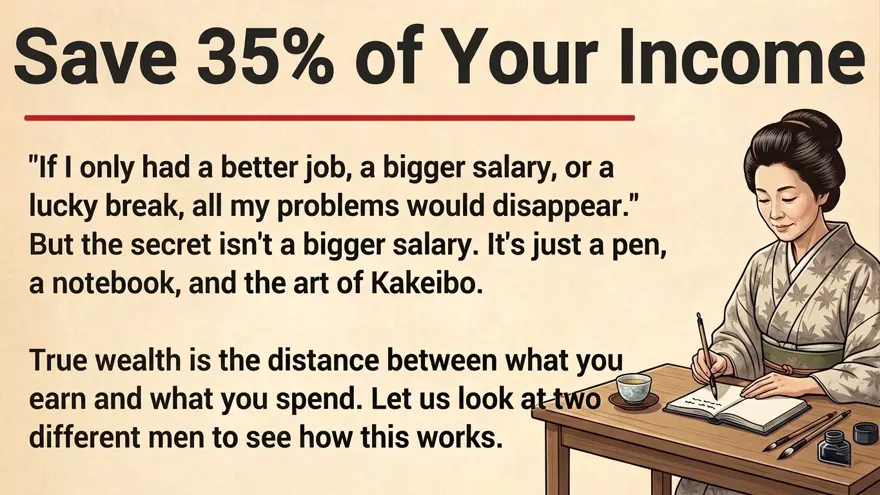
It’s a frustrating cycle. Most of us believe that if we only had a better job, a bigger salary, or a lucky break, all of our financial problems would instantly disappear. But the truth is quite different. Earning more money without fixing your daily spending habits is like pouring water into a giant bucket with a hundred tiny holes—it doesn’t make you richer; it just speeds up the waste.
True wealth isn’t about chasing a massive corporate salary just to spend it all on status symbols. True wealth is the calm, intentional distance between what you earn and what you spend.
If you are tired of watching your hard-earned income slip through your fingers, the secret isn’t a complex digital app or a stressful side hustle. It is a 100-year-old Japanese art of mindful budgeting called Kakeibo (pronounced Kah-kay-boh).
In this guide, we are going to dive into this simple, pen-and-paper method used by secret household CFOs to effortlessly save up to 35% of their income without feeling miserable. Let us look at how this works in real life and how you can patch the leaks in your budget starting today.
Master Your Money: How to Stop Wasting Cash Using the Japanese Art of Kakeibo
The Story of the Two Buckets
Imagine two men standing outside in a heavy rainstorm.
- The first man holds a massive bucket. But this bucket has a hundred tiny holes in the bottom. Rain pours into the top, but leaks out just as fast. This man makes a lot of money, but at the end of the storm, his bucket is empty. He is exhausted, stressed, and broke.
- The second man holds a small cup made of solid steel with no holes. The rain is just a light drizzle for him—he has a low salary. But because his cup is perfectly sealed, he catches every single drop. Once his cup fills up, he pours it into a large barrel, and then into another. At the end of the storm, he is wealthy, while the man with the leaking bucket is begging for water.
[ Leaky Bucket: High Income + High Waste = $0 Savings ]
[ Solid Cup:    Modest Income + Low Waste = Growing Wealth ]
This is the financial reality of our modern world. We are obsessed with making more money. But earning more when you have bad spending habits is like pouring water into a leaking bucket. You don’t get richer; you just speed up the waste. If you don’t patch the holes first, a higher salary will only cause you to buy more expensive things you don’t need.
What is Kakeibo?
The people of Japan understood this trap over a century ago. In 1904, Hani Motoko—Japan’s first female journalist—invented a financial system called Kakeibo (pronounced kah-kay-bo), which means “household financial ledger.”
Kakeibo is not a smartphone app or a complicated Excel sheet. It is a physical notebook and a pen. It is a mindful philosophy that forces you to look your spending habits directly in the face.
For generations, this simple tool has been the secret weapon of Japanese housewives. By acting as the “Chief Financial Officers” of their homes, they routinely saved up to 35% of a modest family income. Kakeibo teaches you how to build real wealth not by earning a CEO’s salary, but by developing the calm discipline of a monk.
The Danger of “Invisible Money”
Why are we so bad at managing money today? Because money has become invisible.
When you tap a plastic card, click “Buy Now” on Amazon, or use Apple Pay, you never actually see cash leave your hand. You never feel the heavy weight of money being traded away. This is frictionless spending. Corporations spend billions of dollars to remove all friction so you spend mindlessly.
Modern Spending Loop:
Tap Card/Phone ➔ Zero Physical Friction ➔ Invisible Loss ➔ End-of-Month Shock
Psychologists have found that handing over physical cash activates the pain centers of the brain. This is called the pain of paying.
When you tap a card, that natural pain is completely numbed. You feel nothing in the moment, and you don’t realize the damage until your monthly statement arrives. By then, it is too late.
Kakeibo works by reintroducing healthy friction. It forces you to write down every single transaction by hand. When you sit down and physically write:
Latte: $6.50
Your brain pauses and thinks. You ask yourself: “Is this coffee really worth the effort of writing it down?” Suddenly, invisible numbers on a screen become a visible reality. You realize you aren’t just spending numbers—you are spending your life energy.
The Four Pillars of Kakeibo
At the start of every month, sit down with your notebook and answer four simple questions:
| Pillar / Question | What It Means |
|---|---|
| 1. How much money do I have available? | Your total predictable income for the month. |
| 2. How much would I like to save? | Your specific savings goal for the month. |
| 3. How much must I spend? | Your fixed, non-negotiable expenses (rent, bills). |
| 4. How can I improve? | Your personal promise or focus area for the month. |
Most people spend first and save whatever is left over (which is usually zero). Kakeibo completely flips the equation:
Income−Savings Goal=Spending Money
You pay yourself first. If you earn $3,000 and your savings goal is $500, you move that $500 away the moment your paycheck arrives. You pretend it doesn’t exist and force yourself to live on the remaining $2,500.
This creates artificial scarcity. When you have less money available, your brain becomes more creative. You naturally stop wasting money and prioritize what you actually need.
A Kakeibo practitioner never looks at their total bank balance to check if they can afford something. Your bank balance lies because it still includes money needed for rent and bills. Your budget is the only thing that tells the truth.
The Four Buckets of Spending
Every evening, take three minutes to write your daily expenses by hand into one of four distinct buckets:
                  [ YOUR TOTAL SPENDING ]
                             |
       +---------------------+---------------------+
       |                     |                     |
 1. SURVIVAL           2. OPTIONAL           3. CULTURE           4. EXTRA
(Rent, Groceries)    (Cafes, Shopping)     (Books, Courses)    (Repairs, Gifts)
- Survival (Needs): Rent, basic food, utilities, transport, and medicine. You cannot cut these to zero, but you can optimize them to be cheaper.
- Optional (Wants): Dining out, shopping, drinks, and subscriptions. This is the leak. This is where your financial battle is won or lost.
- Culture (Mental Enrichment): Books, museums, courses, and movies. Kakeibo encourages this. Investing money to grow your mind is an investment, not a waste. However, it must be tracked.
- Extra (Unplanned): Emergency repairs, medical bills, or sudden gifts.
Tracking daily keeps the memory fresh. If you spent $50 on drinks last night, writing it down the next morning forces you to feel a small sting of regret. That sting stops you from doing it again tonight.
Looking at your finances only at the end of the month is like performing an autopsy—the patient is already dead. Kakeibo is a daily checkup that keeps the patient alive.
Two Methods to Control Impulse Spending
1. The Envelope Method (Cash Stuffing)
For your Optional (Wants) bucket, use physical cash. At the start of the month, withdraw your exact fun budget in cash and put it in a paper envelope.
Leave your cards at home. When you go out, only use cash from that envelope. When the envelope is empty, the fun is over. If you blow your entire budget in the first week, you spend the next three weeks sitting at home. This teaches your brain true self-regulation.
2. The 30-Day “Want vs. Need” Delay
When you see something you want to buy that is not a basic need, do not buy it immediately. Write it down on a “Wish List” page in your notebook and wait 30 days.
After 30 days, look at the list again. 90% of the time, the emotional urge will be completely gone, and you will realize you were just bored or sad when you wanted it. If you still want it just as badly after 30 days, buy it. That is an intentional purchase, not an impulse buy.
Respect for Things (Monozukuri)
The Japanese concept of Monozukuri means having a deep respect for materials and craftsmanship. It connects to Mottainai, which is the regret felt over waste.
Kakeibo teaches you to love what you already have:
- Before buying new shoes, polish your old ones.
- Before buying a new phone, clean your current one and delete junk files.
The modern economy relies on you being constantly unhappy with what you have. Repairing what you own is an act of rebellion—it keeps money in your pocket and makes you the master of your material world.
The Monthly Review (Hansei)
At the end of the month, practice Hansei (reflection). Compare your actual spending to your budget and ask: Where did I fail? Why did I spend so much on takeout? Was I stressed or tired?
This is not about guilt; it is about data collection. You are a scientist studying your own behavior. Once you find your triggers, you can plan free alternatives for next month (like a hot bath instead of an expensive takeout order). This creates a loop of continuous improvement (Kaizen).
Wealth is a Ratio, Not a Number
The rich understand a major secret: wealth is not about your income, it is about the gap between what you earn and what you spend.
[ Person A ] Earning: $200k | Spending: $200k ===> GAP: $0   (No Freedom)
[ Person B ] Earning: $50k  | Spending: $30k  ===> GAP: $20k  (True Wealth)
Person B is actually richer than Person A because Person B owns their time. You cannot always control your income, but you can control your spending today.
Every dollar you save is like a tiny employee working for you. When you save money, you are buying your freedom so that one day you won’t have to work.
Your 7-Day Kakeibo Challenge
Your life is a ledger, and your spending reveals your true values. If you say family is important, but spend $0 on them and $500 on solo hobbies, your ledger shows the truth.
The path to wealth starts with a notebook, not a lottery ticket. Here is your challenge:
For the next 7 days, write down every single cent you spend by hand. Coffee, gas, snacks—everything. At the end of the week, circle the “wants” in red and add them up. You will be shocked by how much money you are unconsciously wasting. Awareness is the first step to change.
What is the one small, guilty-pleasure expense that quietly drains your wallet every month? Identify it, and write down the vow of Kakeibo:
“I master my money. It does not master me.”
✅️ Motivation Life Lesson From This Story with life lessons With simple English to reader:
Here are the powerful motivational life lessons we can learn from this story. These lessons are written in simple English to help you apply them to your daily life.
Lesson 1: Fix Your Habits Before You Try to Get More
The Story Lesson: Earning more money when you have bad habits is like pouring water into a bucket with a hundred holes. You don’t get richer; you just waste money faster.
- For Your Life: Many people think, “If I only had a better job, a bigger salary, or a lucky break, all my problems would disappear.” But more resources will not fix a broken lifestyle. If you cannot manage a small amount of money or time today, you will lose a large amount tomorrow. Fix your inner habits first, and the outer success will follow.
Lesson 2: Bring Back “Healthy Friction” to Your Choices
The Story Lesson: Modern tools make life so easy that we buy things without thinking. Kakeibo forces us to slow down, pick up a pen, and write down our choices by hand.
- For Your Life: We live in a world of instant gratification. Everything is designed to be fast and automatic. To protect your mind and your future, you must build intentional speed bumps. Pause before you react, wait 30 days before you buy a “want,” and think before you speak. Slowing down gives you control.
Lesson 3: True Wealth is Freedom, Not Status
The Story Lesson: Richard made $250,000 but spent it all, leaving him trapped. Maya made $60,000 but saved $25,000, giving her total freedom over her time.
- For Your Life: Do not confuse looking rich with being wealthy. True wealth is not about owning flashy things to impress strangers. True wealth is owning your time, having peace of mind, and being able to walk away from toxic situations. Every dollar you save is a tiny worker buying you a day of freedom.
Lesson 4: Your Actions Show What You Truly Value
The Story Lesson: Your daily budget is a mirror. If you say family is important, but your ledger shows you spend zero time or money on them, you are lying to yourself.
- For Your Life: Stop listening to what you say you care about, and start looking at what you actually do. Your calendar and your bank statement tell the truth about who you are. Align your daily actions with your true soul and values.
Lesson 5: Practice Contentment Through Care (Monozukuri)
The Story Lesson: Instead of chasing newness, look at what you already own. Polish your old shoes, clean your old phone, and find satisfaction in maintenance.
- For Your Life: The world wants you to feel constant dissatisfaction so you keep searching for the next “new thing.” But happiness does not come from consumption; it comes from appreciation. Take care of your health, your relationships, and your belongings. Learn to love what you already have while you work for what you want.
Lesson 6: Look at Mistakes as a Scientist, Not a Judge (Hansei)
The Story Lesson: The monthly review is not about beating yourself up or feeling shame. It is about data collection so you can do better next month.
- For Your Life: You will fail. You will make mistakes, waste time, and fall off track. When this happens, do not waste energy on guilt. Treat yourself like a scientist studying a behavioral experiment. Ask calmly: “Why did I do that? What was the trigger? How can I improve next time?” Continuous improvement (Kaizen) is a steady path of small steps.
Summary Checklist for Life:
- [ ] Patch the leaks: Stop the bad habits before seeking bigger rewards.
- [ ] Pay yourself first: Invest in your future before spending on temporary fun.
- [ ] Delay gratification: Give your emotions 30 days to cool off before making big moves.
- [ ] Own your time: Aim for freedom, not a fancy lifestyle.
Remember the ultimate vow: “I master my choices. They do not master me.”
✅️ Learn English From this Story:
This story is a fantastic tool for learning English! It uses vivid vocabulary, idioms, and metaphors that native speakers use every day to talk about money and life.
Here is a breakdown of the key English lessons you can learn from this text.
1. Key Business & Financial Vocabulary
These are essential words used in the modern professional and financial world:
- Income: The total money you earn from a job or business.
- Example: “He has a high income, but he also has high expenses.”
- Expenses: The money you spend on things.
- Example: “Rent and groceries are my biggest monthly expenses.”
- Fixed Expenses: Bills that stay the same every month and must be paid (like rent or car insurance).
- Budget: A plan that shows how much money you can spend and how much you should save.
- Scarcity: A state where there is not enough of something.
- Example: “The drought caused a scarcity of water.”
- Gratification: A feeling of pleasure or satisfaction.
- Example: “Buying toys online gives people instant gratification.”
2. Idioms and Phrasal Verbs
Native English speakers love using these phrases. Learning them will make you sound much more natural:
- To slip through your fingers: To disappear quickly before you can stop it.
- In the story: Money slips through people’s fingers when they don’t track it.
- To stand side by side: To stand right next to each other, facing the same direction.
- To set in (Panic set in): When a feeling starts to happen and spread.
- Example: “When the lights went out, panic set in.”
- Bone-dry: Completely dry; 100% empty of liquid.
- Example: “The desert ground was bone-dry.”
- To look someone/something directly in the eye (or face): To confront a problem bravely and honestly without hiding.
- In the story: Kakeibo forces you to stare your spending in the face.
- To pay yourself first: A financial rule where you put money into your savings account before you spend money on anything else.
3. Powerful Metaphors (Imagery)
The story uses excellent descriptions to explain big ideas simply. You can use these metaphors in your own English writing or conversations:
- “A leaking bucket”
- Meaning: A system or lifestyle that loses resources as fast as it gains them. If a person says, “My business is a leaky bucket,” it means they make money but lose it to high costs.
- “A financial treadmill” or “The hamster wheel”
- Meaning: Working incredibly hard but staying in the exact same place because your spending rises with your income.
- “A financial autopsy”
- Meaning: Looking at a problem only after it is too late to fix it (looking at a bank statement at the end of the month when the money is already gone).
4. Advanced “Power Words” for Daily Life
If you want to upgrade your vocabulary, practice using these words from the text:
- Frantic (Adjective): Done in a hurried, panicked, and chaotic way.
- Example: “She made a frantic search for her lost car keys.”
- Modest (Adjective): Small, humble, or average (not flashy or expensive).
- Example: “They live in a modest house near the beach.”
- Frictionless (Adjective): Smooth, easy, and without any resistance.
- Example: “The new app makes online shopping completely frictionless.”
- Vulnerable (Adjective): Open to being hurt, or completely honest without hiding behind armor.
- Example: “During the review, he was very vulnerable about his mistakes.”
5. Grammar Focus: “Flip the Equation”
The phrase “to flip something on its head” or “to flip the equation” means to completely reverse the order of how things are done.
- Standard Order: Income ➔ Spend Money ➔ Save what is left.
- Kakeibo Order: Income ➔ Save Money ➔ Spend what is left.
Practice Opportunity: Try to create your own English sentence using the phrase “I need to master my…” in the comment section of your mind today!
Frequently Asked Questions (FAQ) about Kakeibo
Q1: What does the word “Kakeibo” actually mean?
A: Kakeibo (pronounced Kah-kay-boh) is a Japanese word that translates literally to “household financial ledger.” Invented in 1904 by Japan’s first female journalist, Hani Motoko, it is a traditional pen-and-paper method designed to help people manage their household budgets mindfully and intentionally.
Q2: How is Kakeibo different from modern budgeting apps?
A: Modern apps are designed to make spending and tracking completely “frictionless,” which often means we spend money automatically without thinking about it. Kakeibo intentionally brings back “healthy friction.” By forcing you to physically slow down, pick up a pen, and handwrite your choices, it changes your psychological relationship with money and helps you naturally catch emotional spending before it happens.
Q3: What are the 4 core questions of the Kakeibo method?
A: To master your budget using Kakeibo, you must honestly answer four simple questions at the beginning and end of every month:
How much money do I have available? (Your stable income minus fixed expenses like rent).
How much money would I like to save? (Your monthly saving goal).
How much money am I actually spending? (Your tracked daily expenses).
How can I improve next month? (Your mindful monthly reflection).
Q4: Do I have to give up my favorite “wants” to save 35% using this method?
A: Not at all! Kakeibo is not about extreme deprivation or punishing yourself. It is about awareness. By categorizing your spending into four clear pillars (Needs, Wants, Culture, and Unexpected), you learn to cut out the mindless spending that doesn’t actually bring you joy, allowing you to save more while fully appreciating the things you do choose to buy.
Q5: Why does Kakeibo emphasize a monthly reflection over a strict daily limit?
A: In Kakeibo, mistakes are treated like a scientific experiment, not a reason for shame or guilt. The monthly review phase—known as Hansei (mindful reflection)—allows you to look back at your spending data calmly. Instead of beating yourself up for overspending, you learn to ask: “What triggered that choice, and how can I adjust my habits next month?” This focus on continuous, small improvements (Kaizen) leads to long-term financial peace.
📝 Conclusion
🎯 Note from the Curator: Your 7-Day Mindful Saving Challenge
At its core, Kakeibo is much more than a budgeting tool—it is a mirror held up to your daily life. Your bank statement will always reveal what you truly value, no matter what you tell the world. By consciously slowing down, putting pen to paper, and questioning your impulses, you aren’t depriving yourself of joy. Instead, you are giving yourself the ultimate gift: peace of mind and total control over your future.
Now, it’s your turn to take action.
We challenge you to try the Kakeibo method for just the next 7 days. Put away the digital spreadsheets, grab a simple notebook, and track every single cent by hand.
Before you leave today, let’s start the habit together down in the comments. What is your number one guilty-pleasure expense that secretly drains your wallet every month? Confess it below, share your thoughts on the guide, and leave our favorite Kakeibo financial vow to lock it in:
“I master my choices. They do not master me.”


 Relationships Quotes3 years ago
337+ Relationship Quotes And Sayings
- Good Morning Quotes1 year ago
100+ Good Morning Quotes to Brighten Your Day: Inspirational, Romantic & Funny Messages with Images
- Quotes1 year ago
300 Winnie The Pooh Quotes To Fill Your Heart With Joy
- Quotes3 years ago
35 Deep Heart Touching One Sided Love Quotes for Her
- Good Morning Quotes3 years ago
57 of the Good Morning Quotes And Images Positive Energy for Good Morning
- Good Morning Quotes3 years ago
35 of the Good Morning Quotes And Images Positive Energy for Good Morning
- Life Quotes3 years ago
284 Broken Heart Quotes About Breakup And Heartbroken Sayings
- Motivational Quotes3 years ago
265 Motivational & Inspirational Quotes About Life to Succeed


