Self Improvement
7 Habits to Sharpen Your Brain: The Architecture of a Strong Mind
Every single day, an invisible war is happening inside your head. Your brain is either getting sharper, or it is getting weaker—there is no middle ground, and there is no standing still.
The scariest part about this mental decline is that most people are losing the battle without even realizing it. Slowly and quietly, modern lifestyles melt away our focus, damage our memory, drain our emotional control, and erode our self-discipline. We often blame age, stress, or a busy schedule. However, the truth is much simpler: we are accidentally training our brains to fail through daily distractions.
Many people grow up believing that brain power is entirely fixed—that you are either born smart or you aren’t. But modern neuroscience has completely shattered this myth with a concept called neuroplasticity. Your brain is a dynamic, living system that constantly changes, adapts, and rewires its neural pathways based on your repeated actions.
If your days are filled with endless digital scrolling, low-attention content, poor sleep, and constant multitasking, your brain adapts to that chaos. It physically shapes itself to become easily distracted. But if you intentionally introduce focus, deep learning, physical movement, and mental clarity, your brain adapts to strength.
You hold the architectural tools to reshape your own mind. In this article, we will break down seven practical, science-backed habits that will fix your brain from modern overstimulation, build unstoppable discipline, and unlock a winning attitude for lifelong success.
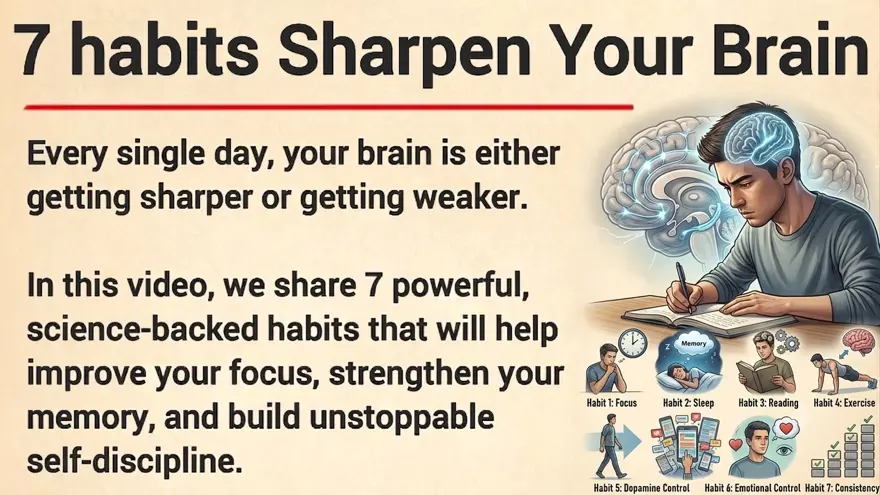
The Architecture of a Strong Mind: 7 Habits to Rewire Your Brain
Every single day, an invisible war is happening inside your head. Your brain is either getting sharper, or it is getting weaker. There is no middle ground, and there is no standing still.
The scariest part about this war is that most people are losing it without even knowing. Slowly, quietly, they are damaging their focus, melting their memory, draining their emotional control, and eroding their discipline. They blame age, they blame stress, or they blame modern life. But the truth is much simpler: they are training their brains to fail.
Many people believe that brain power is something you are born with. You are either born smart or you are not. But modern neuroscience has proven that this is a lie. Your brain possesses a beautiful, powerful quality called neuroplasticity. This means your brain constantly changes, adapts, and re-wires itself based on what you repeatedly do. Every single habit strengthens certain pathways in your mind and weakens others.
If your daily life is filled with endless scrolling, low-attention videos, poor sleep, and constant distraction, your brain adapts to that chaos. It becomes a machine built for distraction. But if you fill your life with deep focus, active learning, physical movement, and intentional quiet, your brain adapts to strength.
You hold the chisel that shapes your own mind. Here are the seven structural habits backed by neuroscience that will help you rebuild it.
Chapter 1: Train Your Focus Like a Muscle
The modern world has launched a massive attack on human attention. The average person cannot focus on a single task for more than a few minutes without a desperate urge to check a notification, open a new tab, or pick up their phone. We treat focus like an optional productivity tool, but neuroscience shows us it is far more than that. Focus is the master key to your entire mind. It directly controls your memory, your ability to learn, your decision-making, and even your emotions.
When you constantly switch your attention from one thing to another, you aren’t actually multitasking. Your brain is frantically jumping back and forth, and every single jump costs energy. Scientists call this the switching cost. This constant task-switching drains your brain’s fuel tank. It explains why you can sit on a couch all day doing nothing productive, yet still feel completely exhausted by the evening. Your brain never received a single moment of uninterrupted peace to think deeply.
To fix this, you must treat focus exactly like a muscle at the gym. You do not start by lifting a hundred pounds; you start with what you can handle.
The 20-Minute Focus Rule: Pick exactly one task. Put your phone in another room. Close every unnecessary tab on your computer. Turn off music with lyrics. For just 20 minutes, give that single task your absolute, undivided attention.
At first, your brain will fight you. You will feel restless. Your mind will scream at you to check a message or look up a random thought. This is completely normal. It is the feeling of a brain experiencing withdrawal from constant stimulation. But if you stay seated and push through that discomfort, something incredible happens over time. The restlessness fades. Your thinking clears. Your memory sharpens, and a deep, calm power takes over. A distracted brain is weak, but a focused brain is unstoppable.
Chapter 2: Sleep Like Your Brain Depends on It
We live in a culture that foolishly glorifies sleep deprivation. People boast about working late into the night on five hours of sleep, viewing it as a badge of honor. But trying to build a sharp mind, high motivation, and clear focus while starving yourself of sleep is like trying to charge a smartphone with a broken cable—you can leave it plugged in all night, but the battery will still die within an hour.
Sleep is not a passive state of rest. Sleep is an active, aggressive maintenance period for your brain.
[Awake Brain]  --> Accumulates metabolic waste & chaotic, disorganized data
      │
[Deep Sleep]   --> Activates Glymphatic System (Flushes toxins & waste products)
      │
[REM Sleep]    --> Consolidates memories, repairs neural tracks, stabilizes emotions
When you deny your brain this vital maintenance window, the consequences are immediate and severe. Your prefrontal cortex—the area of your brain responsible for logic, self-control, and willpower—goes dim. This is why a tired person is emotionally volatile, highly reactive, and incredibly impulsive. When you are exhausted, your brain loses the strength to say “no” to bad habits, poor food choices, and cheap distractions.
If you genuinely want to transform your mind, stop searching for complicated biological hacks and protect your sleep. Go to bed at the exact same time every night. Turn off screens at least an hour before sleep to let your brain produce melatonin naturally. Stop treating sleep deprivation like hard work. A tired brain cannot build a successful life.
Chapter 3: Read Things That Challenge Your Mind
The vast majority of media produced today is designed to keep you entertained, not to make you smarter. It consists of rapid-fire video cuts, sensational headlines, and short bursts of dopamine. Because your brain adapts to what it consumes, shallow media inevitably creates shallow thinking.
Reading is the ultimate antidote to this mental decay. Unlike watching a video—where information is passively poured into your eyes—reading forces your brain to work. Your mind must actively translate symbols on a page into complex images, concepts, logic, and human emotions. It improves your comprehension, expands your imagination, and sharpens your analytical skills.
However, the type of reading matters. To grow your brain, you must read material that sits just above your comfort level.
- What to avoid: Children’s books or overly academic, dense textbooks that make you want to quit immediately.
- What to target: Thought-provoking books on psychology, human behavior, neuroscience, philosophy, history, or biographies of great leaders.
Commit to reading just ten pages every single day. But do not just read to finish the pages—read to understand. Pause at the end of a chapter and challenge yourself with active reflection:
“What was the core message of this section?” “How does this apply to my own life?” “Do I agree with the author’s logic, or is there a flaw in it?”
This active reflection changes the very structure of your thoughts. A truly sharp mind is not a bucket filled with random, useless trivia; it is a finely tuned machine that knows how to analyze, filter, and apply high-value information.
Chapter 4: Exercise for Brainpower, Not Just Appearance
When people hear the word “exercise,” they immediately think of weight loss, building muscle, or looking good at the beach. But the physical benefits of movement are actually secondary. The most profound impact of exercise happens between your ears.
The moment you start moving your body, your heart pumps a fresh wave of oxygen and nutrient-rich blood straight to your head. This physical action triggers the release of a powerful protein called BDNF (Brain-Derived Neurotrophic Factor). Scientists often refer to BDNF as “fertilizer for the brain” because it protects existing brain cells, encourages the growth of new neurons, and strengthens the connections responsible for learning and memory. This is exactly why a short, brisk walk can instantly clear away mental fog and solve a complex problem you’ve been brooding over for hours.
Furthermore, exercise acts as a natural vacuum cleaner for stress hormones like cortisol. Chronic, unmanaged stress physically shrinks the memory centers of your brain and destroys your ability to focus. Regular movement lowers these harmful hormones, shielding your mind from daily anxiety.
You do not need an exhausting, multi-hour gym routine to experience this. A 20 to 30-minute daily habit of walking, running, cycling, or lifting weights is more than enough to elevate your mood and cognitive performance.
Even better, exercise serves as excellent discipline training. Every single time you lace up your shoes and exercise despite feeling lazy or tired, you are teaching your brain a vital lesson: your actions do not depend on your feelings. That single realization is the foundation of all real success.
Chapter 5: Protect Your Mind from Dopamine Overload
We live in a world carefully engineered to hijack human attention. Brilliant engineers spend their entire careers designing applications, algorithms, and notification systems meant to capture your eyes and keep them glued to a screen. Every scroll, every like, and every auto-playing short video floods your brain with a chemical called dopamine.
Dopamine is the molecule of anticipation and reward. In nature, it is released slowly when we achieve hard goals. But modern technology provides massive, unnatural floods of dopamine instantly, with zero effort.
[Natural Reward System] : Hard Work ───────────► Success ──► Slow Dopamine Release
[Modern Hijack System]  : Finger Scroll ───────► Novelty ──► Instant Dopamine Flood
When your brain gets used to this constant, high-volume flood of cheap stimulation, normal life begins to feel painfully boring. Deep work feels like torture, reading ten pages feels impossible, and studying makes you restless. This does not happen because your brain is broken; it happens because your brain has adapted to an overstimulated environment. It has developed a massive tolerance to dopamine.
To reclaim your mind, you must intentionally set firm boundaries around your digital consumption. You don’t have to throw your smartphone into the ocean, but you must stop feeding your brain stimulation every single second it is awake.
- Take a walk without listening to a podcast or checking your phone.
- Sit quietly in a room for five minutes without any entertainment.
- Eat your meals while looking at your food, not at a screen.
- Work on a project without constantly switching tabs to check the news.
When you allow your mind to experience healthy boredom, your dopamine receptors slowly reset. Your focus naturally returns. Your motivation stabilizes, and your mind grows calm. Suddenly, the simple, productive tasks required to build a great life become deeply satisfying again.
Chapter 6: Master Your Emotional Control
A truly sharp mind is defined by much more than pure raw intelligence or technical knowledge. A genius who cannot manage their own emotions is entirely useless. Countless brilliant people destroy their careers, ruin their relationships, and miss incredible life opportunities simply because they are slaves to their temporary feelings. Anger dictates their words, stress paralyzes their actions, fear prevents them from trying, and instant impulses derail their progress.
True emotional intelligence means realizing that your emotions are valuable indicators, but terrible leaders. Neuroscience shows us that when a person learns to regulate their emotions, their logical decision-making improves, and internal mental chaos drops dramatically.
Building this mastery requires three practical shifts in your daily behavior:
1. Create an Intentional Pause
Most emotional damage occurs in the form of an instant, automatic reaction. Someone insults you, and you instantly lash out. A stressful event happens, and you immediately panic. The next time you feel an emotional surge, force yourself to pause for just three seconds. That tiny pause stops the automatic survival response in your brain and gives your logical prefrontal cortex the critical time it needs to take control.
2. Shift Your Internal Language
Stop identifying directly with your temporary emotions. Instead of saying, “I am furious,” or “I am anxious,” reframe the thought to: “I notice that I am feeling anger right now,” or “I observe a sensation of anxiety.” This minor shift in language creates a healthy psychological distance between your identity and your current state. You cease being the storm; you become the observer watching the storm pass by.
3. Support Your Physical Machine
It is nearly impossible to maintain emotional control when your body is running on empty. A lack of sleep, poor nutrition, a high-dopamine diet, and zero movement leave your nervous system highly sensitive and fragile. Your physical habits form the foundation upon which your emotional stability is built.
Chapter 7: Choose Consistency Over Temporary Motivation
This is the most critical principle of self-improvement: Stop waiting for motivation.
Motivation is a fickle, unreliable emotion. It shows up when you watch an inspiring video or read a moving quote, but it vanishes the moment you are tired, cold, stressed, or busy. If you only practice your good habits on the days you feel inspired, your progress will be completely inconsistent. And inconsistency is the absolute death of brain training.
Your brain does not rewire itself based on rare, intense bursts of effort. It rewires itself through relentless, everyday repetition.
| High-Intensity Effort (Low Value) | Consistent Routine (High Value) |
|---|---|
| Reading 100 pages once a month | Reading 10 pages every single day |
| One brutal 3-hour workout a week | Walking 25 minutes every single day |
| A single 12-hour burst of frantic work | Focusing deeply for 45 minutes every day |
Small, daily repetitions build an identity. When you show up and perform a habit every single day—regardless of whether you feel happy, tired, motivated, or lazy—you change the way your brain views you. The action stops being a forced chore and becomes a natural part of who you are.
The people who build extraordinary lives and maintain a winning attitude are not superhuman. They do not possess a magical reservoir of willpower that you lack. They have simply trained themselves to keep showing up, day after day, until their daily routine reshapes their mind.
The Ultimate Choice
Your brain is constantly changing. As you read these final words, it is actively adapting to your choices. The only question that matters is: What are you training it to become?
Are you training your mind for distraction, or for deep focus? Are you teaching it to give in to instant impulses, or to cultivate iron discipline? Are you drowning it in overstimulation, or protecting its clarity?
You do not need perfect genetics, exceptional luck, or a high IQ to sharpen your mind. You simply need better daily patterns. Focus deeply. Protect your sleep. Challenge your mind with reading. Move your body. Step away from constant stimulation. Master your reactions, and show up every single day—even when you don’t feel like it.
If you treat your brain with the respect it deserves, everything else in your life will become easier. Your decisions will improve, your confidence will soar, and your goals will fall into place. Take control of your habits, reshape your mind, and watch your entire life transform.
🙋♂️ Frequently Asked Questions (FAQ)
Q1: Can you actually sharpen your brain after a certain age?
A: Yes, absolutely. For a long time, scientists believed the brain stopped developing after childhood. However, modern neuroscience has proven the concept of neuroplasticity—your brain’s ability to physically change, adapt, and grow new neural pathways at any stage of life based on your repeated daily habits.
Q2: How long does it take to see improvements in focus and memory?
A: If you practice the 20-minute uninterrupted focus rule daily, you will notice an improvement in your mental clarity and calmness within 7 to 14 days. For deeper structural changes, like improved long-term memory and automatic self-discipline, it typically takes 6 to 8 weeks of consistent repetition.
Q3: What if I don’t have time to read 10 pages a day?
A: If 10 pages feels overwhelming, start with just 2 to 3 pages a day, or read for 5 minutes before bed. The goal isn’t massive consumption; it is active processing. Reading even a tiny amount of challenging material consistently trains your brain to think deeper than scrolling through social media ever will.
Q4: How does reducing instant dopamine help my productivity?
A: When your brain is constantly flooded with cheap dopamine from short videos and notifications, it develops a high tolerance to stimulation. As a result, normal tasks like working, studying, or reading feel incredibly boring. By intentionally scheduling moments of quiet and digital boundaries, you reset your dopamine receptors, making simple, productive activities satisfying again.
Q5: What should I do on days when I have zero motivation?
A: Rely on systems instead of feelings. Acknowledge that motivation is temporary and unreliable. On low-energy days, lower the barrier to entry: tell yourself you will only focus on your task for 5 minutes, or walk for just 10 minutes. Once you start, momentum usually takes over. Showing up on the days you don’t feel like it is exactly how iron discipline is built.
📝 Conclusion
The Ultimate Choice for a Stronger Mind
Your brain is a masterful machine that never stops adapting. As you finish reading this article, your neural pathways are already processing your next choice. The ultimate question you must answer is: What are you training your mind to become?
Are you training it for endless distraction, or for deep, uninterrupted focus? Are you allowing temporary impulses to dictate your actions, or are you actively cultivating iron discipline? Are you drowning your mind in dopamine overstimulation, or are you intentionally protecting its clarity?
A Note from the Curator
Rebuilding your mind does not require perfect genetics, an extraordinary IQ, or a massive life upheaval. It simply requires better daily patterns. By focusing deeply for just 20 minutes a day, prioritizing high-quality sleep, reading challenging material, moving your body, and mastering your emotional reactions, you systematically upgrade your brain’s architecture.
The most vital step is practicing consistency even when your temporary motivation completely disappears. Do these things long enough, and you won’t just notice sharper focus—you will experience a total life transformation. Your decisions will improve, your confidence will soar, and achieving your personal goals will finally become easier because a well-trained brain makes everything else possible.
What is one habit you are going to change today to protect your brainpower? Let us know in the comments below!


 Relationships Quotes3 years ago
337+ Relationship Quotes And Sayings
- Good Morning Quotes1 year ago
100+ Good Morning Quotes to Brighten Your Day: Inspirational, Romantic & Funny Messages with Images
- Quotes1 year ago
300 Winnie The Pooh Quotes To Fill Your Heart With Joy
- Quotes3 years ago
35 Deep Heart Touching One Sided Love Quotes for Her
- Good Morning Quotes3 years ago
57 of the Good Morning Quotes And Images Positive Energy for Good Morning
- Good Morning Quotes3 years ago
35 of the Good Morning Quotes And Images Positive Energy for Good Morning
- Life Quotes3 years ago
284 Broken Heart Quotes About Breakup And Heartbroken Sayings
- Motivational Quotes3 years ago
265 Motivational & Inspirational Quotes About Life to Succeed


